Dubai vs Vietnam for Digital Nomads: Why Southeast Asia Is the Smarter Move in 2026
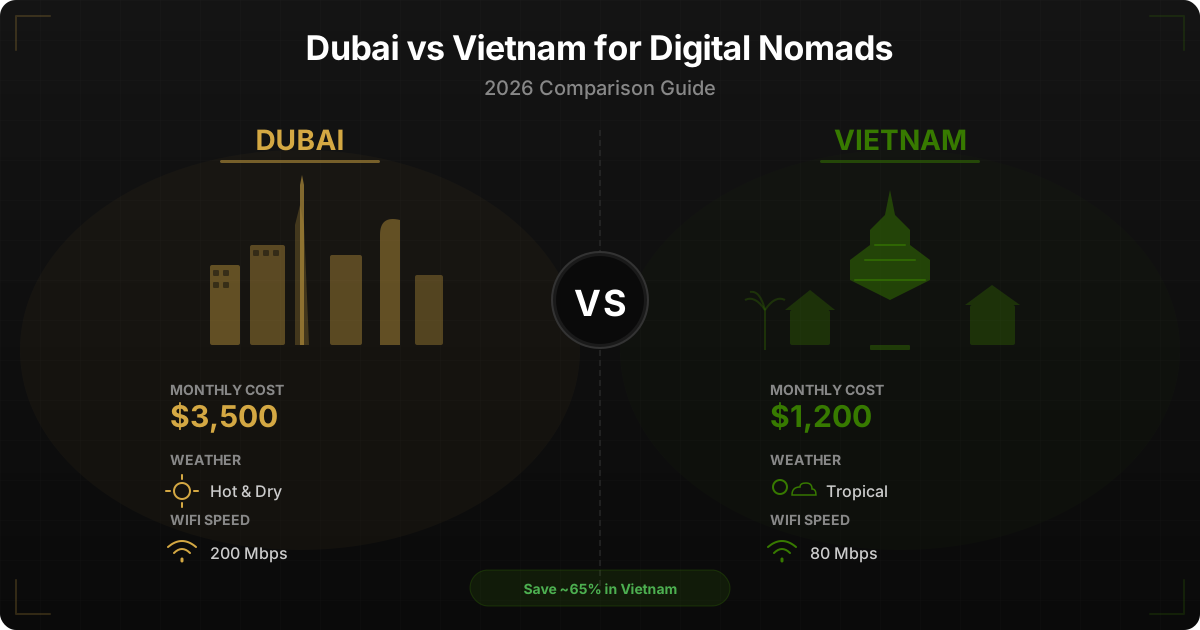
TL;DR: Vietnam beats Dubai for most digital nomads in 2026 — and it is not even close right now. With the Iran-US/Israel conflict disrupting flights, driving up costs, and creating genuine safety concerns in the Gulf, Vietnam offers 50-70% lower living costs, a $25 e-visa, fast internet, and a stable environment. Dubai still wins on tax policy and luxury infrastructure, but unless you are earning north of $10,000/month and specifically need a Gulf presence, Vietnam is the pragmatic move this year.
I have spent time in both Dubai and Vietnam over the past three years, and until recently, the comparison was genuinely close. Dubai had the glamor, the tax advantage, and the unbeatable flight connectivity. Vietnam had the value, the culture, and the lifestyle.
Then February 28, 2026 happened.
The military conflict between Iran and the US/Israel coalition has fundamentally changed the equation for anyone based in or considering Dubai. Emirates is operating at roughly 60% capacity. Over 23,000 flights have been cancelled. Insurance premiums for Gulf-based residents have spiked. And thousands of digital nomads are doing what digital nomads do best — they are relocating.
If you are one of those nomads weighing your options, or if you were already considering Dubai and now need a Plan B, this is the honest comparison you need. I will give Dubai credit where it deserves it, but I will also make the case for why Vietnam is the smarter base for most remote workers in 2026.
Cost of Living: Vietnam Wins Decisively
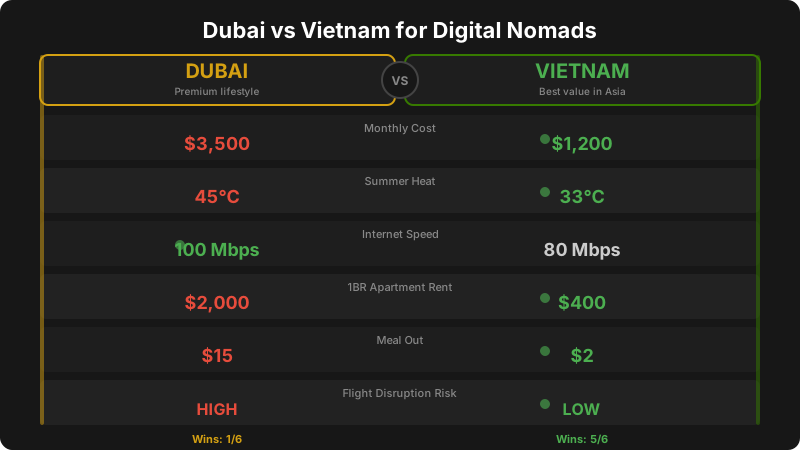
Dubai is expensive. That is not a secret, but many nomads underestimate just how quickly costs add up beyond the Instagram-worthy brunch photos.
Dubai monthly costs (mid-range lifestyle):
- Studio/1BR apartment: $1,500-2,500
- Food (mix of cooking and eating out): $600-900
- Coworking space: $300-600
- Transport (metro + occasional taxi): $200-350
- Mobile/internet: $80-120
- Total: $3,000-5,000/month
Vietnam monthly costs (mid-range lifestyle):
- Studio/1BR apartment: $400-800
- Food (mix of street food, local restaurants, cooking): $250-450
- Coworking space: $50-100
- Transport (motorbike rental or Grab): $50-100
- Mobile/internet: $10-30
- Total: $1,000-2,500/month
The gap is significant at every level. A bowl of pho in Saigon costs $1.50-3. A comparable lunch in Dubai Marina runs $15-25. Your morning ca phe sua da (Vietnamese iced coffee) is $0.75. A flat white at a Dubai café is $5-7.
💡 Tool tip: Moving your money between currencies? Wise gives you the real exchange rate with fees around 0.5%, and their multi-currency account lets you hold both AED and VND. If you are transitioning from Dubai to Vietnam, it is the simplest way to move your savings without losing 2-4% to bank conversion fees.
For the complete Vietnam playbook — neighborhoods, visa walkthroughs, coworking reviews, and 200+ pages of local intel — grab The Digital Nomad Guide: Vietnam.
Monthly Budget Comparison Table
| Category | Vietnam (Budget) | Vietnam (Mid) | Vietnam (Comfortable) | Dubai (Budget) | Dubai (Mid) | Dubai (Comfortable) |
|---|---|---|---|---|---|---|
| Rent | $300-400 | $500-800 | $900-1,500 | $1,000-1,400 | $1,800-2,500 | $3,000-5,000 |
| Food | $150-250 | $300-450 | $500-700 | $400-600 | $700-900 | $1,200-2,000 |
| Coworking | $0-50 | $60-100 | $100-180 | $0-200 | $300-500 | $500-800 |
| Transport | $30-50 | $60-100 | $100-200 | $100-200 | $250-350 | $400-700 |
| Phone/Internet | $8-15 | $15-25 | $30-50 | $60-80 | $80-120 | $120-180 |
| Entertainment | $50-100 | $150-250 | $300-500 | $200-400 | $400-700 | $800-1,500 |
| Monthly Total | $550-850 | $1,100-1,700 | $1,900-3,100 | $1,800-2,900 | $3,500-5,100 | $6,000-10,000+ |
The bottom line: you can live well in Vietnam on what you would spend just on rent in Dubai.
Safety and Stability: The Elephant in the Room
This is the category that has changed everything in 2026.
Dubai’s current situation: The UAE has not been directly attacked, but its proximity to the conflict zone creates real problems. Flight disruptions are constant. The US and UK governments have issued updated travel advisories for the broader Gulf region. Insurance companies have reclassified parts of the UAE as elevated risk. Some employers are pulling staff from the region. The psychological weight of living near an active conflict — even if your daily life feels normal — is real and measurable.
Vietnam’s situation: Vietnam is one of the most politically stable countries in Southeast Asia. It maintains neutral foreign policy relationships with both the US and China. There are no active territorial conflicts affecting daily life. Violent crime rates are low by any global standard. The biggest safety concern for most nomads is motorbike traffic in Ho Chi Minh City, and even that is manageable once you learn the rhythm.
For digital nomads, stability is not just about physical safety. It is about predictability — knowing your flight will not get cancelled, your insurance will not spike, and your daily routine will not be disrupted by geopolitical events outside your control. Vietnam delivers that predictability right now. Dubai cannot.
Visa Options: Vietnam Is Simpler and Cheaper
UAE Freelancer Visa:
- Cost: $1,000+ per year (varies by emirate and free zone)
- Requirements: proof of income, health insurance, bank statements
- Duration: 1-2 years, renewable
- Process: paperwork-heavy, often requires a local sponsor or free zone registration
- Advantage: provides tax residency documentation
Vietnam E-Visa:
- Cost: $25
- Requirements: passport, photo, basic application form
- Duration: 90 days, single entry
- Process: online application, typically approved in 3 business days
- Limitation: no formal right to work (but widely used by remote workers)
Vietnam does not yet have a dedicated digital nomad visa, which is a legitimate gap. But the $25 e-visa gets you 90 days with minimal friction. Many long-stay nomads do visa runs to Thailand, Cambodia, or Singapore — which also happen to be excellent weekend trip destinations. For detailed entry requirements and renewal strategies, check our Vietnam digital nomad visa guide.
The UAE freelancer visa is more robust on paper, but it costs 40x more and ties you to a region currently experiencing significant instability. For most nomads earning under $10,000/month, the simplicity and cost of the Vietnam e-visa is hard to beat.
Internet and Coworking: Closer Than You Think
Both Dubai and Vietnam deliver solid internet for remote work, but the price gap is enormous.
Dubai internet and coworking:
- Apartment internet: 100-500 Mbps, $60-120/month
- Coworking hot desk: $300-600/month
- Premium dedicated desk: $500-900/month
- Top spaces: Astrolabs, Nasab by tejar, WeWork, LETSWORK
Vietnam internet and coworking:
- Apartment internet (fiber): 100-200 Mbps, $8-20/month
- Coworking hot desk: $50-100/month
- Premium dedicated desk: $80-180/month
- Top spaces: Dreamplex (HCMC), Toong (Hanoi/HCMC), Enouvo (Da Nang), CirCO (HCMC)
Vietnam’s café culture also means you can work from hundreds of coffee shops with solid Wi-Fi for the price of a $1.50 drink. Dubai has nice cafés too, but expect to spend $6-10 for the privilege.
Upload and download speeds in both countries handle video calls, large file transfers, and streaming without issues. Vietnam occasionally has submarine cable outages affecting international routing, but these are infrequent and most coworking spaces have backup connections.
💡 Tool tip: NordVPN is worth having in Vietnam — it secures your connection on public Wi-Fi, lets you access region-locked content from home, and handles the occasional website block that pops up in the country. It also worked reliably for me in Dubai’s more restricted internet environment.
Time Zones: Depends on Your Clients
Dubai (GMT+4):
- Overlaps well with Europe (3-4 hours behind CET)
- Manageable for UK clients (same-day overlap)
- Tough for US clients (8-12 hours ahead)
- Good for India and East Africa
Vietnam (GMT+7):
- Solid overlap with Australia and East Asia
- Morning overlap with India and the Middle East
- Evening overlap with Europe (5-6 hours ahead of CET)
- Night owl schedule needed for US clients (12-15 hours ahead)
Neither location is perfect for all time zones. Dubai has the edge for Europe and Middle East clients. Vietnam works better for the Asia-Pacific region. If your clients are primarily US-based, both locations require schedule adjustments — though Vietnam’s evenings align with US mornings slightly better for West Coast clients.
Food and Lifestyle: Two Completely Different Experiences
Dubai offers a polished, international lifestyle. World-class restaurants, luxury malls, pristine beaches, and a nightlife scene that caters to every taste. It is comfortable, clean, and impressive. But it can also feel manufactured. The social scene often revolves around spending money — brunches, clubs, beach clubs, and dining out.
Vietnam offers something Dubai cannot replicate: authenticity. The street food alone is reason enough to move. Morning banh mi from a cart for $1. Bun cha on a tiny plastic stool in Hanoi. Fresh seafood on the Da Nang beach for $5. Vietnamese cuisine is consistently ranked among the best in the world, and you experience it at its source for a fraction of what you would pay anywhere else.
The lifestyle difference goes deeper than food. Vietnam gives you motorbike adventures through rice paddies, weekend trips to Ha Long Bay or the Mekong Delta, mountain treks in Sapa, and a genuine sense of place. Dubai gives you indoor ski slopes and a very tall building. Both are valid — but after a few months, most nomads I know crave substance over spectacle.
Flight Connectivity: Dubai’s Biggest Loss
This was Dubai’s crown jewel. Dubai International Airport (DXB) was the world’s busiest international hub. Emirates and flydubai connected you to virtually anywhere on the planet with a single layover at most.
That advantage has been severely damaged by the current conflict. With Emirates at roughly 60% capacity and tens of thousands of flights cancelled, routing through Dubai is no longer the reliable play it once was. Nomads who previously built their travel schedules around Dubai as a hub are now scrambling.
Vietnam’s growing airport network does not match Dubai’s pre-conflict reach, but it is better connected than many nomads realize:
- Ho Chi Minh City (SGN): Direct flights to Bangkok, Singapore, Kuala Lumpur, Tokyo, Seoul, Hong Kong, Sydney, London, San Francisco, and more
- Hanoi (HAN): Strong connections across Asia, plus direct routes to London, Paris, and Frankfurt
- Da Nang (DAD): Regional connections to Singapore, Seoul, Tokyo, Bangkok, and Kuala Lumpur
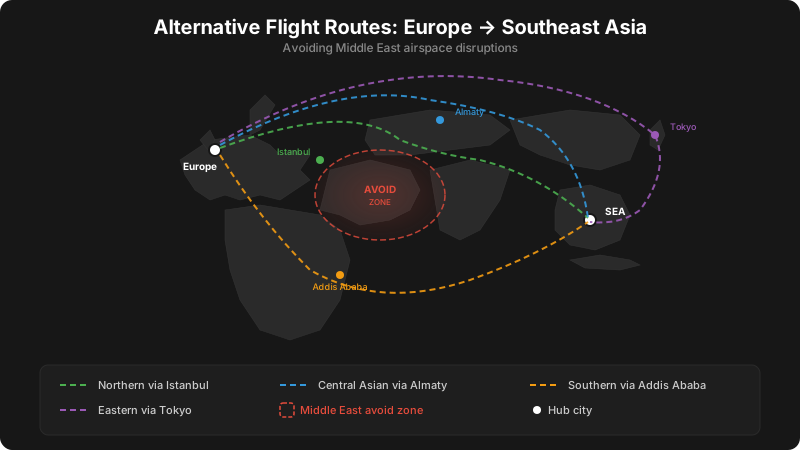
For connections to Europe and the Americas, Singapore and Bangkok serve as excellent secondary hubs — and they are 1-2 hour flights from Vietnam. For routing strategies that avoid the Middle East entirely, see our guide on how to fly Europe to Southeast Asia without Middle East transit.
Community: Both Have Strong Nomad Scenes
Dubai’s nomad community was booming pre-conflict. The city attracted entrepreneurs, crypto folks, influencers, and remote workers drawn by the tax advantage and lifestyle. Networking events, masterminds, and coworking meetups were plentiful. That community is now fragmenting as people relocate — many to Southeast Asia, Portugal, and the Balkans.
Vietnam’s nomad community has been growing steadily and is now absorbing a wave of Dubai expats:
- Da Nang: The most concentrated nomad hub. Beach town with a tight-knit community, regular meetups, and a walkable/bikeable layout that makes socializing easy.
- Ho Chi Minh City (Saigon): Bigger, more diverse, more entrepreneurial. Multiple nomad neighborhoods (District 1, District 2/Thao Dien, District 7). Startup scene is active.
- Hanoi: Smaller nomad community but growing fast. Old Quarter charm, strong cultural immersion, and the lowest costs of the three cities.
If you are leaving Dubai’s social scene, Da Nang will likely feel the most welcoming for a soft landing. The community is warm, events are frequent, and the town is small enough that you will see familiar faces within your first week.
For detailed neighborhood comparisons and cost breakdowns by city, see our cost of living in Vietnam city-by-city breakdown.
Tax Situation: Dubai’s One Clear Win
Let me be honest: the UAE’s 0% personal income tax is a genuine, significant advantage. If tax optimization is your primary concern and you earn substantial income, Dubai’s tax framework is hard to beat on paper.
UAE tax reality:
- 0% personal income tax
- No capital gains tax for individuals
- 9% corporate tax introduced in 2023 (applies to business profits over AED 375,000)
- Clean tax residency certificate available
Vietnam tax reality for digital nomads:
- Progressive income tax rates from 5% to 35% for tax residents
- Tax residency triggered after 183 days in-country
- In practice, enforcement on foreign remote workers earning from overseas clients on tourist visas is minimal
- No tax treaty abuse — most nomads operate in a legal gray area
- Vietnam does not issue tax residency certificates to short-stay visitors
The math gets interesting when you factor in cost of living. If you earn $5,000/month, Dubai’s 0% tax saves you roughly $0 in Vietnam because most nomads at that income level are not paying Vietnamese tax anyway. Meanwhile, you are spending $2,000-3,000 more per month on living expenses in Dubai. The tax advantage only becomes material at higher income levels — roughly $8,000-10,000+ per month — where the savings outweigh the cost differential.
If you are among those digital nomads looking at alternatives to Dubai, tax is worth thinking about carefully, but it should not be the only factor.
Weather: Vietnam Has Seasons, Dubai Has Summer
Dubai weather is binary. October through April is pleasant — warm, sunny, 20-30°C. May through September is brutally hot, regularly exceeding 45°C with oppressive humidity. You will not want to be outside for more than a few minutes during summer. This effectively makes Dubai a 6-month destination for anyone who values outdoor activity.
Vietnam weather varies by region and offers more options:
- Ho Chi Minh City: Tropical, 25-35°C year-round. Dry season (Nov-Apr) and wet season (May-Oct) with afternoon downpours.
- Da Nang: Warm most of the year (25-35°C), with a rainy season from September to December. Best weather February through August.
- Hanoi: Distinct seasons. Hot summers (June-Aug, 30-38°C), cool winters (Dec-Feb, 10-18°C), and pleasant spring/autumn months.
The advantage of Vietnam’s geography is that you can climate-hop within the country. Too hot in Saigon? Head to Da Lat in the central highlands where it is 20-25°C year-round. Want cool weather? Hanoi’s winter and Sapa’s mountains deliver. Dubai does not offer that flexibility — when it is hot, the entire country is hot.
Head-to-Head Comparison Table
| Category | Dubai | Vietnam | Winner |
|---|---|---|---|
| Monthly Cost (mid-range) | $3,500-5,000 | $1,100-1,700 | Vietnam |
| Safety (March 2026) | Elevated risk, conflict proximity | Stable, low crime | Vietnam |
| Visa Cost | $1,000+/year | $25/90 days | Vietnam |
| Visa Simplicity | Complex, paperwork-heavy | Online, 3-day approval | Vietnam |
| Internet Speed | 100-500 Mbps | 80-200 Mbps | Dubai (slightly) |
| Coworking Cost | $300-600/month | $50-100/month | Vietnam |
| Time Zone (Europe) | GMT+4 (better overlap) | GMT+7 (evening overlap) | Dubai |
| Time Zone (Asia-Pacific) | GMT+4 (limited) | GMT+7 (strong overlap) | Vietnam |
| Food Quality | Excellent (international) | Exceptional (local + value) | Vietnam |
| Food Cost | $600-900/month | $250-450/month | Vietnam |
| Flight Connectivity | Severely reduced (2026) | Strong regional, growing global | Tie (2026) |
| Nomad Community | Fragmenting | Growing | Vietnam (2026 trend) |
| Income Tax | 0% | 0-35% (rarely enforced on nomads) | Dubai |
| Weather Flexibility | 6 usable months | Year-round options | Vietnam |
| Cultural Experience | International/curated | Authentic/immersive | Subjective |
| Luxury Infrastructure | World-class | Limited | Dubai |
Final tally: Vietnam leads in 10 categories, Dubai leads in 3, with 2 ties or subjective calls. And that is being generous to Dubai given the current situation.
Making the Move: Dubai to Vietnam Playbook
If you are currently in Dubai and considering the switch, here is a practical roadmap:
Before You Leave Dubai
- Secure your banking. Keep your UAE bank account active if possible — it is useful for receiving payments tax-efficiently. Ensure your cards work internationally.
- Download offline maps of your destination city in Vietnam. Google Maps works well there, but Grab (the local ride-hailing app) is essential — download it before you arrive.
- Book your flight strategically. Routes through Singapore, Bangkok, or Kuala Lumpur are your safest bet right now. Avoid routing through the conflict zone. Direct flights from Dubai to Ho Chi Minh City on Vietnam Airlines or Emirates (when operating) take roughly 6 hours.
- Apply for your Vietnam e-visa at least one week before travel at evisa.xuatnhapcanh.gov.vn. Cost is $25, processing takes 3 business days.
- Arrange short-term accommodation for your first week. Airbnb works in Vietnam, but Facebook groups for expat housing in your target city will get you better long-term deals.
Your First Week in Vietnam
- Get a local SIM card at the airport. Viettel or Mobifone — roughly $5-10 for a month of data. Alternatively, install an Airalo eSIM before you leave Dubai so you have data working the moment you land — no queue, no physical SIM swap required.
- Set up Grab for transport and food delivery. It is the Uber of Southeast Asia and works flawlessly in Vietnam.
- Open a Vietnamese bank account if staying long-term. Techcombank and VPBank are nomad-friendly. You will need your passport and a Vietnamese phone number.
- Scout coworking spaces in person. Most offer free day passes or trial periods.
- Join local nomad communities. Facebook groups, Nomad List meetups, and coworking space events are the fastest way to build a social network.
Long-Term Setup
- Apartment hunting: Use Facebook groups (search “[City Name] Apartments for Rent”) rather than listing sites. Negotiate directly with landlords for the best rates.
- Visa renewal: Plan your first visa run around day 80. Thailand and Cambodia are the easiest runs — and double as weekend getaways.
- Health insurance: Keep international coverage. Safetywing and World Nomads both work well in Vietnam. Local hospitals in major cities are affordable even without insurance for minor issues.
The Honest Take
I am not going to pretend Vietnam is perfect. It is not.
The bureaucracy can be frustrating. The visa situation lacks the long-term clarity of a proper digital nomad visa. Traffic in Ho Chi Minh City is genuinely chaotic. Air quality in Hanoi can be poor during certain months. And if you are accustomed to Dubai’s polished, everything-works-perfectly infrastructure, Vietnam’s rougher edges will require adjustment.
But here is what Vietnam gives you that Dubai cannot in 2026: peace of mind at a price that lets you actually save money. You can live well, eat extraordinarily, work productively, and explore a fascinating country — all while spending less than you would on rent alone in Dubai Marina.
The conflict in the Middle East may resolve. Dubai may bounce back. Emirates will eventually return to full capacity. And when that happens, Dubai will again be a compelling option for nomads who value tax efficiency and luxury.
But right now, in March 2026, the math and the risk calculus both point the same direction: southeast. And if timezone alignment with US clients matters more than rock-bottom costs, Brazil’s northeast coast deserves a look too — beach towns like Praia da Pipa offer a similar lifestyle upgrade at costs that compete with Vietnam, plus full overlap with US business hours.
Ready to make the switch from Dubai to Vietnam? The Digital Nomad Guide: Vietnam has everything you need to hit the ground running — get the PDF direct (+ exclusive bonuses) for $15, or on Amazon for $9.99.
Keep Reading
- Vietnam Digital Nomad Visa Guide 2026 — E-visa, business visa, and Golden Visa options for your move to Vietnam
- Cost of Living in Vietnam for Digital Nomads: 2026 City-by-City Breakdown — Detailed budgets for Da Nang, Ho Chi Minh City, Hanoi, and Hoi An
- Where Digital Nomads Are Going After Dubai: 7 Safe Alternatives — Vietnam plus six more proven destinations for nomads leaving the Gulf
Joe Atlas is the author of The Digital Nomad Guide: Vietnam and has been working remotely from Southeast Asia since 2021. He writes at digital-nomad-guides.com.