How to Fly from Europe to Southeast Asia Without Transiting the Middle East (2026)
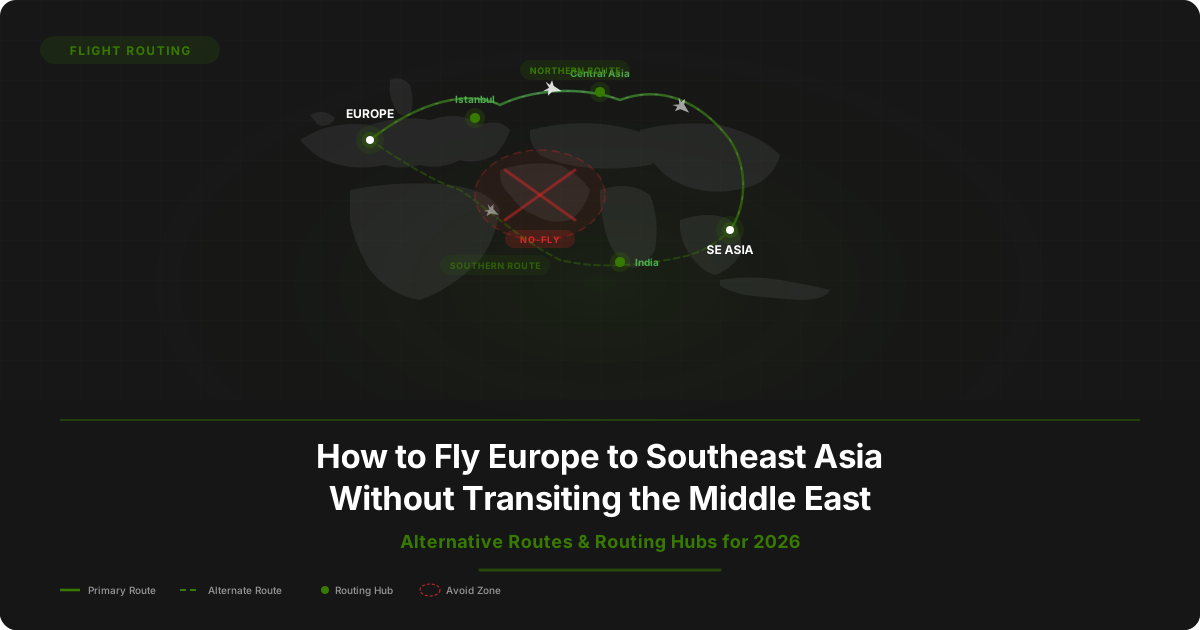
TL;DR: The cheapest and most reliable ways to fly Europe to Southeast Asia in 2026 without Middle East transit are Finnair via Helsinki (northern route, from around EUR 450 one-way), Turkish Airlines via Istanbul, and Chinese carriers via Guangzhou or Beijing. Singapore Airlines nonstop from London or Zurich is the most comfortable but priciest option. All seven alternatives below avoid closed Middle East airspace entirely.
I’m Joe Atlas, and I’ve been flying between Europe and Southeast Asia several times a year for the better part of a decade. Until 2024, my default was always the same: grab a cheap Emirates or Qatar Airways ticket, enjoy the lounge in Dubai or Doha, and land in Bangkok or Ho Chi Minh City feeling reasonably human. That playbook no longer works.
Since late 2025, Middle East airspace has been in serious trouble. Iran, Iraq, Qatar, Bahrain, Syria, and Israeli airspace are fully closed to commercial overflights. UAE and Kuwait are heavily restricted, with corridor availability changing week to week. CNN reported in early 2026 that major Gulf carriers have been forced to reroute hundreds of flights, and SimpleFlying has documented the cascading schedule changes across the industry.
If you are a digital nomad, long-term traveler, or remote worker planning a move from Europe to Southeast Asia this year, here are seven routing options that avoid the Middle East entirely.
Route Comparison Table
| Airline(s) | Hub | Sample Route | Approx. Journey Time | One-Way Price Range (EUR) | Middle East Avoidance |
|---|---|---|---|---|---|
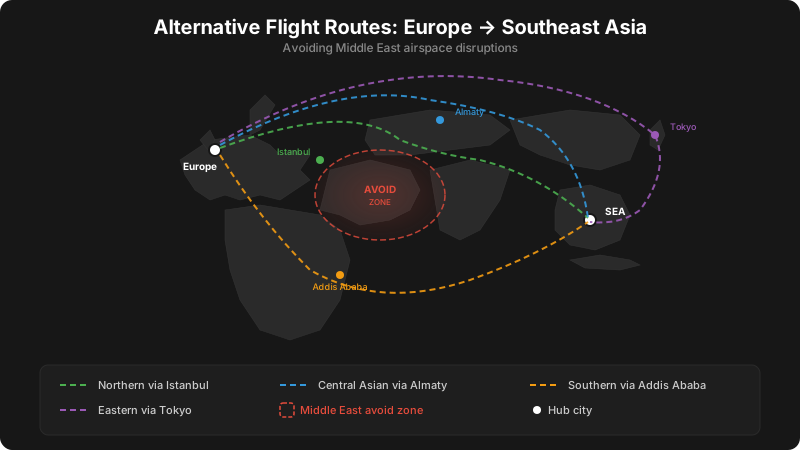
| Finnair | Helsinki (HEL) | London-Helsinki-Bangkok | 13-15h (1 stop) | 450-750 | Full (northern polar route) |
| Turkish Airlines | Istanbul (IST) | Berlin-Istanbul-Bangkok | 14-16h (1 stop) | 400-700 | Full (Turkey airspace open) |
| Singapore Airlines | Singapore (SIN) | London-Singapore (nonstop) | 12-13h (nonstop) | 600-1,200 | Full (southern/eastern route) |
| Cathay Pacific | Hong Kong (HKG) | London-Hong Kong-Bangkok | 15-17h (1 stop) | 550-950 | Full (eastern route) |
| China Southern / Air China | Guangzhou (CAN) / Beijing (PEK) | Paris-Guangzhou-Bangkok | 16-20h (1 stop) | 350-650 | Full (Central Asian route) |
| Korean Air / Asiana | Seoul (ICN) | Frankfurt-Seoul-Bangkok | 16-19h (1 stop) | 500-850 | Full (northeast route) |
| JAL / ANA | Tokyo (NRT/HND) | London-Tokyo-Bangkok | 17-21h (1 stop) | 550-1,000 | Full (northeast route) |
Prices are indicative for March-June 2026. Actual fares vary by booking date, class, and availability.
1. Finnair via Helsinki — The Northern Route
Finnair has become the standout winner of the Middle East airspace crisis. The airline’s Helsinki hub sits at the geographic sweet spot for northern routing between Europe and Asia, and Finnair’s entire long-haul strategy has historically leaned on this advantage.
- Key European departures: London, Paris, Amsterdam, Berlin, Barcelona, Rome, Dublin
- Southeast Asian destinations: Bangkok (BKK), Singapore (SIN), Ho Chi Minh City (SGN), with seasonal service to Phuket
- Journey time: 10-11 hours Helsinki to Bangkok direct; 13-15 hours total from Western European cities with the Helsinki connection
- Price range: EUR 450-750 one-way in economy
- Pros: Shortest total routing; completely avoids Middle East airspace using the northern polar path over Scandinavia and Siberia; Helsinki Airport is efficient with short connection times (often 1-2 hours); strong on-time record
- Cons: Limited frequency on some Southeast Asian routes (not daily to all destinations); Helsinki connections can be tight during winter weather disruptions; premium cabin availability is limited
Finnair has reportedly seen a 30-40% surge in bookings on Asia routes since late 2025, so book early. This is my personal top pick for reliability and speed.
2. Turkish Airlines via Istanbul
Turkey’s airspace remains fully open, and Istanbul serves as a massive connecting hub with reach across both Europe and Asia. Turkish Airlines operates one of the world’s largest route networks, which gives you flexibility on both the European departure and the Asian destination end.
- Key European departures: London, Paris, Berlin, Amsterdam, Frankfurt, Vienna, Barcelona, Rome, Warsaw, Prague, Athens, and dozens more
- Southeast Asian destinations: Bangkok, Kuala Lumpur (KUL), Singapore, Ho Chi Minh City, Jakarta (CGK), Hanoi (HAN), Bali/Denpasar (DPS)
- Journey time: 14-16 hours total with Istanbul connection
- Price range: EUR 400-700 one-way in economy
- Pros: Enormous European network means connections from almost any city; competitive pricing; excellent lounge in Istanbul; good frequency on Southeast Asian routes
- Cons: Istanbul Airport connections can involve long walks between terminals; flights to Asia from Istanbul route south via Egypt and the Red Sea or east through Central Asian airspace, adding some flight time compared to pre-crisis; occasional schedule changes due to regional airspace shifts
Turkish Airlines reroutes its Asia-bound flights through corridors over the Caucasus, Afghanistan, or south via Egypt depending on the specific destination. The airline has been transparent about routing changes, which I appreciate.
3. Singapore Airlines via Singapore — Nonstop Comfort
If budget is less of a concern and you want the most direct, comfortable option, Singapore Airlines offers nonstop flights from several European cities directly to Singapore. From Changi Airport, onward connections to anywhere in Southeast Asia are trivially easy.
- Key European departures: London (LHR), Zurich (ZRH), Frankfurt (FRA), Paris (CDG), Amsterdam (AMS), Barcelona (BCN), Milan (MXP)
- Southeast Asian destinations: Singapore hub with connections to Bangkok, Kuala Lumpur, Ho Chi Minh City, Hanoi, Jakarta, Bali, Manila, Phnom Penh, Yangon, and more
- Journey time: 12-13 hours nonstop to Singapore; add 1-4 hours for onward connection
- Price range: EUR 600-1,200 one-way in economy (premium economy and business significantly more)
- Pros: Nonstop from multiple European cities; consistently rated among the world’s best airlines; Changi Airport is excellent for layovers; massive onward network within Southeast Asia
- Cons: Premium pricing; Singapore is at the southern end of Southeast Asia, so onward flights to northern destinations (Hanoi, Chiang Mai) add time; popular routes sell out quickly
4. Cathay Pacific via Hong Kong
Hong Kong remains a strong connecting hub for Europe-to-Southeast-Asia travel. Cathay Pacific has been quietly picking up market share as Gulf carriers have pulled back.
- Key European departures: London (LHR), Manchester (MAN), Paris (CDG), Amsterdam (AMS), Frankfurt (FRA), Milan (MXP), Madrid (MAD)
- Southeast Asian destinations: Bangkok, Ho Chi Minh City, Singapore, Kuala Lumpur, Manila, Bali, Phnom Penh, Da Nang
- Journey time: 15-17 hours total with Hong Kong connection
- Price range: EUR 550-950 one-way in economy
- Pros: Strong onward network into Southeast Asia and beyond; Hong Kong Airport is efficient; frequent flyer program (Asia Miles) is useful for the region; routing avoids Middle East entirely via a northeastern path
- Cons: Higher prices than Turkish or Chinese carriers; Hong Kong connections add time for southern Southeast Asian destinations; availability can be tight during peak season
5. China Southern and Air China via Guangzhou or Beijing
Chinese carriers offer some of the lowest fares on the Europe-to-Southeast-Asia corridor, and their Central Asian routing avoids the Middle East completely. The tradeoff is longer journey times and a less polished experience compared to premium carriers.
- Key European departures: London, Paris, Amsterdam, Frankfurt, Rome, Moscow, Istanbul
- Southeast Asian destinations: Bangkok, Kuala Lumpur, Singapore, Ho Chi Minh City, Hanoi, Jakarta, Manila, Phnom Penh
- Journey time: 16-20 hours total depending on connection time in China
- Price range: EUR 350-650 one-way in economy
- Pros: Often the cheapest option; good frequency; Guangzhou and Beijing have extensive Southeast Asian networks; routing over Central Asia avoids all conflict zones
- Cons: Longer layovers common (sometimes 4-8 hours); Chinese transit visa requirements may apply depending on your nationality (144-hour visa-free transit available for many passport holders); service quality varies; WiFi limited on many aircraft
If you are budget-conscious and time-flexible, China Southern from Paris or Amsterdam to Guangzhou, then onward to Bangkok or Ho Chi Minh City, is hard to beat on price.
6. Korean Air and Asiana via Seoul
South Korea’s Incheon Airport is one of the best connecting airports in Asia, and both Korean Air and Asiana offer solid service between Europe and Seoul with extensive Southeast Asian connections.
- Key European departures: London, Paris, Frankfurt, Amsterdam, Rome, Zurich, Prague, Barcelona
- Southeast Asian destinations: Bangkok, Ho Chi Minh City, Hanoi, Singapore, Kuala Lumpur, Manila, Bali, Phnom Penh, Chiang Mai (seasonal)
- Journey time: 16-19 hours total with Seoul connection
- Price range: EUR 500-850 one-way in economy
- Pros: Excellent service quality; Incheon Airport is consistently top-rated (great for layovers); Northeast routing completely avoids Middle East; strong frequency on Southeast Asian routes
- Cons: Longer total journey time than Finnair or Singapore Airlines; Seoul is geographically further from Southeast Asia than other hubs; some routes only operate a few times per week
7. Japan Airlines (JAL) and ANA via Tokyo
Japanese carriers offer a premium experience with Tokyo Narita or Haneda as the connecting point. The northeast routing over Russia to Tokyo avoids the Middle East entirely.
- Key European departures: London (LHR), Paris (CDG), Frankfurt (FRA), Helsinki (HEL), Munich (MUC)
- Southeast Asian destinations: Bangkok, Singapore, Ho Chi Minh City, Hanoi, Jakarta, Manila, Kuala Lumpur
- Journey time: 17-21 hours total with Tokyo connection
- Price range: EUR 550-1,000 one-way in economy
- Pros: Outstanding service; modern aircraft with good entertainment and WiFi; Tokyo airports are efficient; can combine with a Japan stopover
- Cons: Longest routing of all options listed here; higher fares than Chinese or Turkish alternatives; fewer Southeast Asian destinations served directly compared to other hubs
What About Emirates and Etihad?
The question I get most often: can you still fly Emirates or Etihad?
The short answer is yes, but with major caveats. As of March 2026, both airlines are operating at approximately 60% of their pre-crisis capacity on Europe-Asia routes. Flights that do operate are rerouting either north via the Caucasus and Afghanistan or south via Egypt and the Red Sea, adding 2-4 hours to typical journey times.
Here is what that means practically:
- Schedule reliability is poor. Routes are being added and dropped with little notice. A flight that exists when you book may not exist when you travel.
- Prices have not dropped proportionally. Despite reduced capacity, Gulf carriers have not slashed fares significantly because demand still exists and fuel costs for longer routes are higher.
- Connection times in Dubai and Abu Dhabi have become unpredictable. Ground operations are stressed by the irregular scheduling.
- Some codeshare and partner airline tickets routed through Gulf hubs are being involuntarily rerouted. If you booked through a partner airline, check whether your routing has changed.
My recommendation: unless you have a specific reason to fly a Gulf carrier (loyalty status, specific fare deal, preferred cabin product), choose one of the seven alternatives above for more predictable travel in 2026.
Practical Tips for Booking in 2026
1. Build in schedule flexibility. Airspace situations can change. Book refundable or changeable tickets where possible, even if they cost slightly more. Many airlines have extended their flexible booking policies in response to the crisis.
2. Get the right travel insurance. Standard policies may not cover disruptions caused by conflict-zone airspace closures. Look for policies that explicitly cover geopolitical events, airspace closures, and involuntary rerouting. World Nomads and SafetyWing both offer policies used by digital nomads, but read the fine print on conflict-related exclusions.
3. Check airspace status before you fly. The EUROCONTROL Network Operations Portal provides real-time information on European airspace. For broader coverage, NOTAM databases show active airspace restrictions worldwide.
4. Book 6-8 weeks in advance. Availability on alternative routes is tighter than usual. Last-minute bookings on popular routes like Finnair Helsinki-Bangkok or Singapore Airlines London-Singapore are frequently sold out or priced at a premium.
5. Use a VPN when searching for flights. Airline pricing varies by your browsing location and currency. NordVPN lets you search from different country servers to compare fares — a flight priced in Thai baht or Vietnamese dong sometimes costs less than the same ticket priced in euros. It also secures your connection when booking on airport or hotel Wi-Fi.
6. Consider positioning flights. If you are based in Southern or Eastern Europe, a cheap intra-European flight to Helsinki, Istanbul, or London can open up better long-haul options. Budget carriers like Ryanair and Wizz Air make positioning flights affordable.
7. Consider Latin America instead. If the routing complexity is pushing you toward a different destination entirely, transatlantic flights to Latin America are completely unaffected by the Middle East closures. Brazil has a digital nomad visa with a low income threshold, and coastal towns in the northeast offer a lifestyle comparable to Southeast Asia at similar costs. Our Southeast Asia vs Latin America comparison covers the trade-offs in detail.
8. Monitor airline communications. Sign up for schedule change alerts from your airline. In the current environment, proactive monitoring saves you from showing up at the airport to find a cancelled or rerouted flight.
Heading to Vietnam?
If Southeast Asia is your destination and Vietnam is on the list, I wrote a complete guide covering visas, cost of living, coworking spaces, and city-by-city breakdowns for digital nomads. Get the Vietnam digital nomad guide here.
💡 Tool tip: Before your flight lands, install an Airalo eSIM for your destination country. You will have mobile data the moment you clear immigration — no hunting for SIM card kiosks after a 15-hour journey. They cover 200+ countries with instant activation, and you can set it up over airport Wi-Fi during your layover.
Frequently Asked Questions
Why are flights through the Middle East disrupted in 2026? As of early 2026, airspace over Iran, Iraq, Qatar, Bahrain, Syria, and Israel is fully closed to commercial overflights. UAE and Kuwait airspace is heavily restricted. This has forced Gulf carriers and other airlines that historically routed through the region to reroute or cancel services.
Can I still fly Emirates or Etihad from Europe to Southeast Asia? Yes, but both airlines are operating at roughly 60% capacity on affected routes. Flights are rerouting via Egypt or the Caucasus, adding hours to journey times. Schedules change frequently.
What is the fastest way to fly from Europe to Southeast Asia without transiting the Middle East? Finnair via Helsinki (northern route) offers approximately 13-15 hours total from Western European cities to Bangkok. Singapore Airlines nonstop from London to Singapore is 12-13 hours.
Are flights avoiding the Middle East more expensive than usual? Yes, typically 15-30% higher than 2024 levels due to increased demand on alternative routes, longer flight paths, and reduced overall capacity.
Which airlines fly the northern route over Russia and Central Asia? Finnair uses the northern polar route from Helsinki. Chinese carriers route via Central Asia. Korean Air, Asiana, JAL, and ANA fly northeast over Siberia.
Is travel insurance different when Middle East airspace is closed? Standard policies still apply, but you should verify coverage for trip disruptions caused by airspace closures and geopolitical events. Look for policies with explicit conflict-related disruption coverage.
What if my flight gets rerouted through the Middle East unexpectedly? Airlines cannot legally route through fully closed airspace. If your carrier uses partially restricted corridors, you may see last-minute route changes. Book airlines that avoid the region entirely for maximum predictability.
Should I book one-way or round-trip tickets in the current situation? One-way tickets offer more flexibility. The price gap between one-way and round-trip has narrowed on many routes, and one-way bookings let you adjust return routing if the situation changes.
Sources and further reading:
- CNN Travel — Middle East airspace closures and airline rerouting coverage
- SimpleFlying — Airline schedule changes and rerouting analysis
- Wego Travel — Booking trends and fare data for rerouted flights
- EUROCONTROL — Real-time European airspace operations
For more travel and remote work guides, check out the rest of our blog.
Keep Reading
- Where Digital Nomads Are Going After Dubai: 7 Safe Alternatives — Destination breakdowns with cost, visa, and internet details for each alternative
- Vietnam Digital Nomad Visa Guide 2026 — Landing in Vietnam? Full visa walkthrough from e-visa to long-stay options
- Cost of Living in Vietnam for Digital Nomads: 2026 City-by-City Breakdown — What to budget once you arrive in Da Nang, HCMC, Hanoi, or Hoi An
— Joe Atlas