Southeast Asia vs Latin America for Digital Nomads: The 2026 Comparison Guide
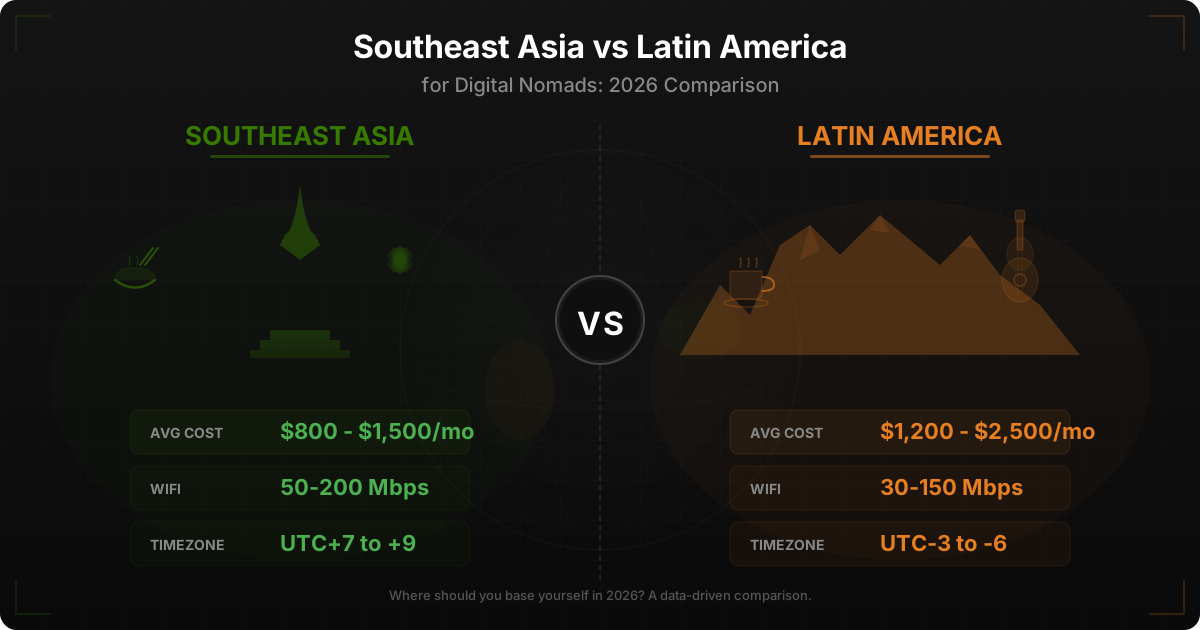
TL;DR: Southeast Asia wins on cost of living, internet infrastructure, and food value. Latin America wins on timezone alignment with US clients, language learning, and cultural immersion. Neither region is objectively better — the right choice depends on your work schedule, budget, and what kind of life you want outside the laptop. If you work US hours, lean Latam. If you want to stretch every dollar, lean SEA. Both regions are absorbing a wave of nomads relocating from Dubai and the wider MENA region in 2026.
I have spent extended stretches in both regions — years across Vietnam, Thailand, and Bali on the SEA side, and months in Colombia, Mexico, and Argentina on the Latam side. This is not a theoretical comparison. Every number, observation, and recommendation below comes from either my own experience or verified reports from nomads I know and trust.
The timing of this guide matters. Since the Iran-US/Israel conflict escalated in late February 2026, thousands of digital nomads have evacuated Dubai and other MENA bases. Both Southeast Asia and Latin America are absorbing these relocations, and the nomad communities in both regions are growing fast. If you are making a move right now, this comparison should help you decide which direction to go.
Master Comparison Table
Before diving into the detail, here is the side-by-side overview across every category covered in this guide.
| Category | Southeast Asia | Latin America | Edge |
|---|---|---|---|
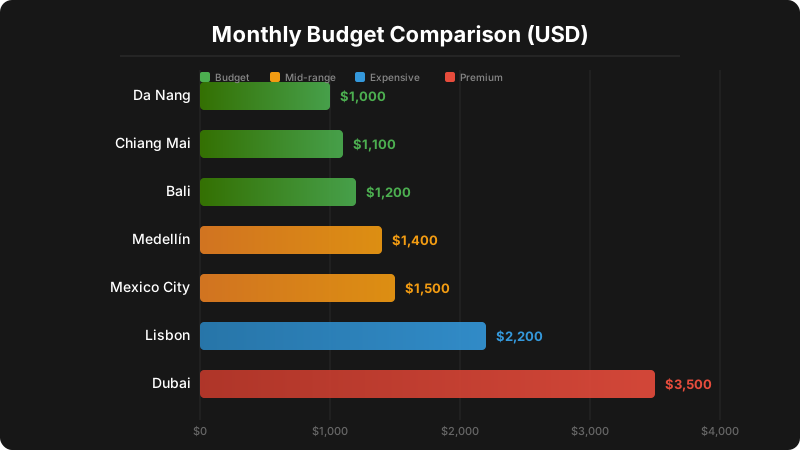
| Cost of Living | $1,000-$1,800/month | $1,400-$2,500/month | SEA |
| Visa Options | 30-90 day tourist/e-visas; DTV, B211A for longer stays | 90-180 day tourist entries; Brazil & Colombia nomad visas | Tie |
| Internet Speed | 50-300 Mbps, fiber widespread | 30-100 Mbps, improving fast | SEA |
| US Timezone Overlap | Minimal (12-14h offset) | Strong (0-3h offset) | Latam |
| EU Timezone Overlap | Moderate (5-7h offset) | Moderate (5-6h offset) | Tie |
| Safety | Generally safe; petty crime | Varies more by city; petty + some violent crime | SEA (slightly) |
| Community & Nightlife | Established hubs; large meetup scene | Growing fast; more local integration | Tie |
| Food & Lifestyle | Exceptional street food; tropical | Diverse cuisine; varied climates | Tie |
| Healthcare | Thailand & Malaysia world-class; very affordable | Strong private systems; affordable | Tie |
| Flight Connectivity | Disrupted from Europe (Middle East rerouting) | Unaffected transatlantic routes | Latam |
| Language Learning | English widely spoken; local languages niche | Spanish immersion; globally useful skill | Latam |
Cost of Living
Southeast Asia is 20-40% cheaper than Latin America for a comparable digital nomad lifestyle. The gap is most visible in food and accommodation. A street meal in Vietnam or Thailand costs $1-3, while a comparable meal in Mexico or Colombia runs $3-6. Monthly rent for a furnished one-bedroom in a nomad-friendly neighborhood runs $300-600 in most SEA cities versus $500-1,000 in Latam.
City-by-City Monthly Budget Estimates
| City | Rent (1BR) | Food | Coworking | Transport | Total |
|---|---|---|---|---|---|
| Da Nang, Vietnam | $350-500 | $200-350 | $80-120 | $30-50 | $1,000-$1,400 |
| Chiang Mai, Thailand | $400-600 | $250-400 | $80-150 | $50-80 | $1,100-$1,500 |
| Canggu, Bali | $500-800 | $300-450 | $100-180 | $60-100 | $1,300-$1,800 |
| Kuala Lumpur, Malaysia | $500-750 | $250-400 | $100-150 | $40-70 | $1,200-$1,700 |
| Medellin, Colombia | $500-800 | $300-450 | $100-150 | $40-70 | $1,400-$1,800 |
| Mexico City, Mexico | $600-1,000 | $350-500 | $100-180 | $50-80 | $1,500-$2,200 |
| Florianopolis, Brazil | $600-900 | $350-500 | $120-180 | $50-80 | $1,500-$2,000 |
| Praia da Pipa, Brazil | $400-700 | $250-400 | $80-120 | $30-50 | $1,100-$1,600 |
| Buenos Aires, Argentina | $400-700 | $300-450 | $80-140 | $30-60 | $1,400-$1,800 |
All figures in USD. Budgets assume a comfortable but not luxury lifestyle: private furnished apartment, eating a mix of home-cooked and restaurant meals, dedicated coworking desk, and local transport. Alcohol, travel, and entertainment are extra.
A few notes on these numbers. Buenos Aires looks deceptively cheap because the Argentine peso remains weak against the dollar, but inflation means prices shift month to month. Mexico City has gotten noticeably more expensive since 2023 as nomad demand has pushed up rents in Roma, Condesa, and Juarez. On the SEA side, Bali’s Canggu has had the same rent inflation problem — it is no longer the budget destination it was five years ago.
One Latam wildcard worth flagging: Praia da Pipa in northeastern Brazil. It is a small coastal town in Rio Grande do Norte with a growing expat community, reliable internet in the town center, and monthly costs that come in 25-30% below Florianopolis. The trade-off is less coworking infrastructure and a smaller international scene, but for nomads who want a beach lifestyle on a genuine budget in Brazil, Pipa is increasingly on the radar. Pipa Market tracks real estate listings and pricing trends across the area if you want to see what housing actually costs there.
💡 Tool tip: Whichever region you choose, Wise is essential for managing multiple currencies. Their multi-currency account lets you hold USD, VND, THB, MXN, and COP simultaneously, converting at the real exchange rate with ~0.5% fees. In countries with volatile currencies like Argentina, having instant access to mid-market rates saves real money.
For a deeper breakdown of Vietnam specifically, including neighborhood-by-neighborhood pricing, see our cost of living guide for Vietnam.
Visa Options
Neither region has a perfect visa solution for digital nomads, but both have workable paths. The trend across both regions is toward longer stays with less bureaucratic friction.
Southeast Asia Visa Options
| Country | Visa Type | Duration | Cost | Notes |
|---|---|---|---|---|
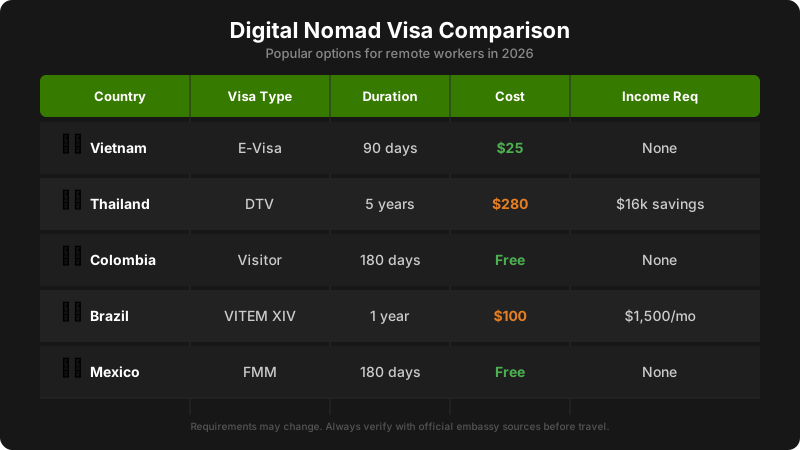
| Thailand | Destination Thailand Visa (DTV) | 180 days (extendable) | ~$280 | Requires proof of remote work or freelance income |
| Malaysia | DE Rantau Pass | 12 months (renewable) | ~$218 | Minimum income $24,000/year; tech workers preferred |
| Indonesia | B211A Remote Worker | Up to 180 days | ~$300-500 | Bali-focused; requires proof of employment or freelance contract |
| Vietnam | E-visa | 90 days (multiple entry) | $25-50 | No dedicated nomad visa; visa runs every 90 days |
Thailand’s DTV has been a game-changer since its launch. It is the most accessible dedicated nomad visa in the region and the one I hear the most positive feedback about. Vietnam still lacks a formal nomad visa, but the 90-day e-visa with periodic visa runs works well in practice and costs almost nothing.
Latin America Visa Options
| Country | Visa Type | Duration | Cost | Notes |
|---|---|---|---|---|
| Mexico | FMM Tourist Permit | 180 days | Free (included with entry) | No income proof needed; renewal requires exit and re-entry |
| Colombia | Digital Nomad Visa | 2 years | ~$200-300 | Minimum income $3x Colombian minimum wage (~$900/month) |
| Brazil | VITEM XIV Digital Nomad Visa | 1 year (renewable) | ~$100-200 | Minimum income $1,500/month; fully legal remote work authorization |
| Argentina | Tourist entry | 90 days (extendable to 180) | Free for many nationalities | Extensions available at immigration; Rentista visa for longer stays |
Mexico’s 180-day visa-free entry is the simplest option on either list. You land, get stamped in, and have six months without a single form to fill out beyond the immigration card. Colombia’s digital nomad visa is well-designed and offers the longest initial stay at two years. Brazil’s VITEM XIV is newer but gives full legal authorization to work remotely, which removes the gray-area anxiety that hangs over tourist visa arrangements.
The verdict on visas: Latin America edges ahead on simplicity and duration. Mexico’s 180 days and Colombia’s 2-year nomad visa beat anything available in SEA for hassle-free long stays. But if you are focused on Southeast Asia, Thailand’s DTV is excellent and Malaysia’s DE Rantau is underrated.
Internet and Infrastructure
Southeast Asia has a clear infrastructure advantage in 2026. Fiber internet is widespread across urban areas in Vietnam, Thailand, and Malaysia. Kuala Lumpur is the standout performer with residential connections routinely hitting 100-300 Mbps. Even mid-range Vietnamese cities like Da Nang deliver 50-80 Mbps reliably.
Latin America has improved dramatically but remains more inconsistent. Mexico City and Buenos Aires have good fiber coverage in central neighborhoods, averaging 50-100 Mbps. Medellin’s Poblado and Laureles areas are solid at 40-80 Mbps. But step outside the main nomad zones and speeds drop sharply. Florianopolis can be hit-or-miss depending on the neighborhood. Smaller Brazilian coastal towns like Praia da Pipa typically offer 20-50 Mbps in the town center, which is workable for most remote tasks but not ideal for bandwidth-intensive work.
Internet and Coworking Comparison
| City | Avg. Download Speed | Fiber Availability | Coworking Spaces | Avg. Coworking Price |
|---|---|---|---|---|
| Kuala Lumpur | 100-300 Mbps | Widespread | 50+ | $100-150/mo |
| Da Nang | 50-80 Mbps | Widespread in urban areas | 15+ | $80-120/mo |
| Chiang Mai | 50-100 Mbps | Good coverage | 40+ | $80-150/mo |
| Canggu, Bali | 30-60 Mbps | Patchy | 60+ | $100-180/mo |
| Mexico City | 50-100 Mbps | Good in central areas | 80+ | $100-180/mo |
| Medellin | 40-80 Mbps | Good in Poblado/Laureles | 30+ | $100-150/mo |
| Buenos Aires | 50-80 Mbps | Good in Palermo/Recoleta | 40+ | $80-140/mo |
| Florianopolis | 40-70 Mbps | Inconsistent | 10+ | $120-180/mo |
Coworking density is worth noting. Mexico City has the most coworking spaces of any city on this list by raw count, which reflects its massive size and booming nomad scene. Chiang Mai and Bali have the highest coworking-spaces-per-nomad ratio — you are never more than a short walk or ride from a reliable desk.
One factor that does not show up in speed tests: power reliability. Bali and parts of Colombia experience occasional outages. If uninterrupted power matters for your work (live calls, real-time collaboration), KL, Chiang Mai, and Mexico City are the most reliable.
💡 Tool tip: Whichever region you land in, having mobile data from day one matters. Airalo sells eSIMs for 200+ countries with instant activation — install one before your flight lands and skip the airport SIM card queue entirely. Especially useful if you are hopping between countries in either region.
Time Zones
This is where Latin America pulls decisively ahead for anyone working with North American clients. If your team or clients are in the US, timezone is not a minor convenience factor — it determines your entire daily routine.
| City | UTC Offset | US East Coast Overlap | US West Coast Overlap | EU (CET) Overlap |
|---|---|---|---|---|
| Mexico City | UTC-6 | 7-8 overlapping hours | 6-7 overlapping hours | 3-4 overlapping hours |
| Medellin | UTC-5 | 8 overlapping hours (same zone) | 5-6 overlapping hours | 4-5 overlapping hours |
| Buenos Aires | UTC-3 | 5-6 overlapping hours | 3-4 overlapping hours | 5-6 overlapping hours |
| Florianopolis | UTC-3 | 5-6 overlapping hours | 3-4 overlapping hours | 5-6 overlapping hours |
| Chiang Mai | UTC+7 | 1-2 overlapping hours | 0-1 overlapping hours | 5-6 overlapping hours |
| Da Nang | UTC+7 | 1-2 overlapping hours | 0-1 overlapping hours | 5-6 overlapping hours |
| Bali | UTC+8 | 1 overlapping hour | 0 overlapping hours | 4-5 overlapping hours |
| Kuala Lumpur | UTC+8 | 1 overlapping hour | 0 overlapping hours | 4-5 overlapping hours |
This table tells a clear story. From Medellin, you share full business hours with New York. From Chiang Mai, your 9am call with a New York client happens at 9pm your time. That is manageable occasionally but brutal as a daily routine.
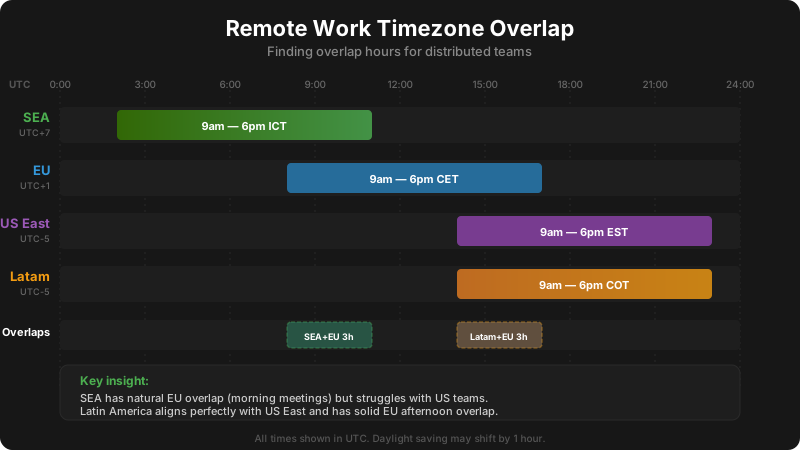
For European clients, the gap narrows. Both SEA (UTC+7/+8) and Latam (UTC-3 to UTC-6) have comparable overlap with Central European Time, roughly 4-6 hours of shared business time. Neither is perfect, and both require some schedule flexibility.
If you work asynchronously and do not have regular calls, timezone matters less. Many nomads in SEA work a shifted schedule — late morning to evening local time — and handle async communication perfectly well. But if your work involves live collaboration, Latam’s timezone advantage is hard to overstate.
Safety
Both regions are safe enough for digital nomads who exercise standard precautions, but the nature of risks differs. This is an area where generalizations are misleading. Safety in both regions is hyperlocal — it varies by city, neighborhood, and even street.
Southeast Asia
SEA’s primary safety concerns are petty crime (bag snatching, phone theft), traffic accidents (especially motorbike-related), and scams targeting tourists. Violent crime against foreigners is rare in all four featured cities. Thailand and Malaysia consistently rank among the safest countries in Asia for visitors. Vietnam has very low rates of violent crime. Bali’s risks are mostly road-related and petty theft.
The most dangerous thing most nomads do in SEA is ride a motorbike. This is not a joke. Traffic fatalities in Vietnam and Thailand are among the highest per capita in the world, and most serious injuries to foreigners involve two-wheeled transport.
Latin America
Latam safety concerns include petty crime (pickpocketing, phone theft), express kidnapping (rare but real in some cities), and neighborhood-specific violent crime. Medellin, Mexico City, and Buenos Aires all have well-defined safe zones where nomads concentrate, and serious incidents within these zones are uncommon. But the margins are thinner than in SEA — a wrong turn in an unfamiliar area carries higher stakes in some Latam cities.
Mexico City’s Roma and Condesa neighborhoods are genuinely safe and walkable. Medellin’s Poblado is heavily policed and tourist-friendly. Buenos Aires’s Palermo is comparable to any European neighborhood. The pattern is consistent: stick to established nomad areas, avoid walking alone late at night in unfamiliar neighborhoods, and do not display expensive electronics unnecessarily.
The Honest Assessment
SEA has a wider safety floor. The worst that typically happens in Chiang Mai or Da Nang is losing a phone to a drive-by snatcher. In Latam, the worst-case scenarios are more severe, even if they are statistically rare in nomad-frequented areas. Neither region should stop you from going — millions of people live safely in all of these cities. But if personal safety is your primary decision factor, SEA offers a slightly wider margin of comfort.
Community and Nightlife
Both regions have thriving nomad communities, but the social texture is different. SEA nomad hubs tend toward international co-living and coworking spaces where English is the common language. Latam communities blend more with local culture, partly because Spanish proficiency opens doors that English alone cannot.
Southeast Asia
Chiang Mai is the OG nomad hub. The community is mature, with weekly meetups, established coworking spaces like Punspace and CAMP, and a social calendar that includes everything from hiking groups to startup pitch nights. Da Nang’s community is smaller but growing fast, with a more tight-knit feel. Bali’s Canggu is the most social scene on this list — sometimes to a fault. It can feel more like a party destination than a work destination depending on your crowd. KL’s nomad scene is quieter but appeals to those who want a modern city without the backpacker energy.
Nightlife in SEA ranges from Bali’s beach clubs and Chiang Mai’s Nimmanhaemin bar scene to Da Nang’s more relaxed riverside restaurants. Bangkok (a common weekend trip from Chiang Mai) has world-class nightlife.
Latin America
Mexico City is the fastest-growing nomad hub in the world right now. The communities in Roma and Condesa are large, diverse, and deeply integrated with local Mexican culture. Medellin’s Poblado has a well-established international scene with a strong emphasis on coworking events and language exchange. Buenos Aires attracts a more artsy, European-influenced crowd, with cafe culture and tango as central social elements. Florianopolis is the smallest and most seasonal — it peaks during Brazilian summer (December-March) and quiets down considerably from April onward. Smaller Brazilian beach towns like Praia da Pipa are starting to attract nomads looking for a less crowded alternative with lower rent, though the community infrastructure is still maturing.
Nightlife in Latam is genuinely better than SEA for most people’s tastes. Salsa clubs in Medellin and Cali, mezcal bars in Mexico City, tango milongas in Buenos Aires — the going-out culture is richer and more varied, and it happens later. Dinner at 9pm and going out at midnight is standard across Latam, which suits nomads who work into the evening.
The Social Verdict
If you want a plug-and-play nomad community where you can find coworking buddies on day one, SEA is easier. If you want deeper cultural integration and are willing to invest in learning Spanish, Latam rewards you with a social experience that feels less “expat bubble” and more genuinely local.
Food and Lifestyle
This is the most subjective category, but it matters enormously for long-term satisfaction.
Southeast Asia
SEA street food is legendary for a reason. A bowl of pho in Da Nang costs $1.50. A plate of pad Thai in Chiang Mai costs $2. A nasi goreng in Bali costs $2-3. The variety is staggering — Vietnamese, Thai, Indonesian, Malaysian, Japanese, Korean, and Chinese food are all widely available and affordable. Vegetarian and vegan options are abundant, particularly in Chiang Mai and Bali.
Weather is consistently warm to hot across the region, with a wet season and a dry season. Air conditioning is a necessity, not a luxury, from April through October in most SEA cities.
The lifestyle leans toward wellness culture — yoga, meditation, surfing, diving. Bali is ground zero for this, but Chiang Mai and Da Nang have strong wellness scenes too.
If Vietnam is calling, get the complete guide with 200+ pages of practical advice: The Digital Nomad Guide: Vietnam
Latin America
Latam cuisine is heavier but deeply satisfying. Colombian bandeja paisa, Mexican tacos al pastor, Argentine asado, Brazilian feijoada — the food is built around grains, beans, meat, and fresh fruit. Fresh juice culture is excellent across the continent. The coffee in Colombia is world-class and absurdly cheap ($1-2 for a specialty pour-over in Medellin).
Weather varies more than in SEA. Mexico City sits at 2,240 meters and has spring-like weather year-round (15-25C). Medellin is called “the city of eternal spring” for good reason (20-28C). Buenos Aires has proper seasons, including a cold winter. Florianopolis is warm from November through March and cool the rest of the year.
The lifestyle leans toward social experiences — dancing, dining, language exchange, live music. The cultural learning curve is steeper than SEA (unless you speak Spanish), but the payoff is a richer sense of place.
The Food Verdict
If you prioritize variety, value, and ease of eating healthy on the cheap, SEA wins. If you prioritize social dining, coffee culture, and cultural depth through food, Latam wins. Neither will leave you hungry or unsatisfied.
Healthcare
Both regions offer high-quality private healthcare at a fraction of US or European prices. The key is always going private rather than relying on public systems.
Southeast Asia
Thailand and Malaysia are global medical tourism destinations. Bangkok’s Bumrungrad International Hospital is JCI-accredited and handles everything from dental work to cardiac surgery at prices 50-80% below US rates. Kuala Lumpur’s private hospitals are similarly excellent. Vietnam’s healthcare quality varies more — Hanoi and Ho Chi Minh City have good international clinics, but smaller cities have limited English-speaking facilities. Bali’s medical options are adequate for routine care but serious cases often require medevac to Singapore or Bangkok.
A general practitioner visit in SEA costs $20-50 at a private clinic. Dental cleaning runs $30-60. A course of antibiotics costs $5-15 out of pocket.
Latin America
Colombia and Mexico have strong private hospital networks. Medellin’s Clinica Las Americas and Hospital Pablo Tobon Uribe are well-regarded. Mexico City has several internationally accredited hospitals. Buenos Aires benefits from Argentina’s strong medical tradition — quality is high and prices are low due to the weak peso. Brazil’s private system (SUS) is solid in major cities.
A general practitioner visit in Latam costs $30-60 at a private clinic. Dental cleaning runs $40-80. Prescription medication is affordable and widely available without the pricing issues common in the US.
Insurance
For both regions, international health insurance is the standard approach. Always confirm that your specific destination is covered before buying.
💡 Tool tip: SafetyWing is the most popular insurance choice in nomad communities because their Nomad Insurance (~$45/month) covers 180+ countries across both SEA and Latin America, does not require a fixed address, and can be purchased after you have already left home.
Flight Connectivity
The Middle East conflict has tilted this category sharply in Latin America’s favor for nomads coming from Europe. Transatlantic routes to Latin America are completely unaffected by the airspace closures. A flight from London or Paris to Mexico City or Bogota takes 10-12 hours with direct options available on multiple carriers.
Getting from Europe to Southeast Asia now requires routing around closed Middle East airspace. Practical options include Finnair’s northern route via Helsinki, Turkish Airlines via Istanbul, or Singapore Airlines nonstop from London. These work, but they add cost (15-30% premium over 2024 prices) and complexity.
From North America, both regions are similarly accessible. Mexico City is a 4-5 hour flight from most US cities. Bangkok is reachable via direct flights from the US West Coast (17-18 hours) or one-stop via Tokyo or Seoul.
Intra-Region Connectivity
Both regions have excellent budget airline networks for hopping between cities.
- SEA: AirAsia, VietJet, Scoot, and Lion Air connect all major hubs for $30-100 per flight. Bangkok to Chiang Mai costs $20-40. Da Nang to Bali costs $80-150 with one stop.
- Latam: Viva Aerobus, Volaris, JetSmart, and GOL offer comparable pricing. Mexico City to Medellin runs $150-250. Buenos Aires to Florianopolis costs $80-150.
SEA has a slight edge on intra-region budget flights thanks to AirAsia’s extensive network and competitive pricing, but both regions make city-hopping affordable.
The Slowmad Factor
The nomad lifestyle has shifted. The “new country every month” approach that defined early digital nomadism has given way to the slowmad model: settling in one city for 3-6 months, establishing routines, building local relationships, and actually experiencing a place beyond its coworking spaces and cafes.
Both regions reward slowmads, but in different ways.
Slowmadding in SEA
Longer stays in SEA unlock significant cost savings. Monthly apartment rates in Da Nang drop from $500-600 for a short-term rental to $350-400 for a 3-6 month lease. Chiang Mai and KL show similar discounts for committed stays. You also build relationships with local restaurants, gym owners, and neighbors that make daily life smoother and more affordable.
The visa structures in SEA are designed for stays of 60-90 days, so slowmads often need to do visa runs — short trips to a neighboring country to reset the clock. This is well-established and easy (Da Nang to Bangkok, Chiang Mai to Vientiane, Bali to Kuala Lumpur), but it is an added logistical step.
Slowmadding in Latam
Latin America’s visa structures are more slowmad-friendly. Mexico’s 180-day FMM means you can spend six months without a single border run. Colombia’s digital nomad visa gives you two years. This removes one of the biggest friction points of the nomad lifestyle.
The real reward of slowmadding in Latam is language acquisition. Three months of daily Spanish immersion — supplemented by cheap local tutoring ($8-15/hour in Medellin or Mexico City) — can take you from beginner to conversational. Six months can get you to genuine fluency. That is a life skill that pays dividends long after you leave.
The 2026 Context: Post-MENA Nomad Migration
This guide would be incomplete without acknowledging the specific moment we are in. The escalation of the Iran-US/Israel conflict in late February 2026 has created the largest single displacement event in digital nomad history. Thousands of remote workers based in Dubai, Abu Dhabi, Bahrain, and other Gulf cities are relocating, and they are splitting roughly evenly between SEA and Latam.
The nomads heading to SEA tend to be those who prioritize cost savings and were already familiar with the region. Many had previous stints in Thailand or Bali and are returning to known ground. The nomads heading to Latam tend to be those with US-based clients who cannot afford the timezone disruption, or those who already spoke some Spanish.
This migration is straining housing in the most popular neighborhoods. Canggu, Poblado, and Roma/Condesa are all seeing rental price spikes. If you are relocating now, consider second-tier neighborhoods or less obvious cities. Da Nang over Bali. Laureles over Poblado. Coyoacan over Roma.
The Verdict: Choose SEA If… Choose Latam If…
Choose Southeast Asia If:
- Your budget is tight. You will get a meaningfully better lifestyle per dollar in SEA, especially for food and accommodation.
- Internet reliability is non-negotiable. KL and Vietnam’s fiber infrastructure is hard to beat.
- You work with Asia-Pacific clients or teams. The timezone alignment is obvious.
- You work asynchronously. If you do not have daily US-hours calls, SEA’s timezone offset becomes irrelevant.
- You want established nomad infrastructure. Chiang Mai, Bali, and KL have years of accumulated nomad-friendly services.
- Warm weather year-round is a priority. SEA delivers consistent tropical warmth.
Choose Latin America If:
- You work US business hours. This is the single biggest factor. If you have daily standups at 9am Eastern, Latam is not optional — it is necessary.
- You want to learn Spanish. The immersion opportunity is unmatched and the skill has global value.
- You are coming from Europe and want easy flight access. Transatlantic routes are unaffected by the Middle East disruptions.
- Nightlife and social culture matter to you. Latam’s going-out culture is richer, later, and more varied.
- You prefer longer visa stays without border runs. Mexico’s 180 days and Colombia’s 2-year nomad visa are hard to beat.
- You want varied climates. From Mexico City’s eternal spring to Buenos Aires’ four seasons, Latam offers more weather variety.
The Honest Answer
There is no wrong choice. I have been genuinely happy in both regions and will continue splitting my time between them. If you are making this decision for the first time, pick the one that solves your biggest constraint — whether that is budget, timezone, or lifestyle preferences — and give it at least three months before judging. The slowmad approach works in both places, and switching between them is easy and affordable.
Ready to make the move to Southeast Asia? Start with The Digital Nomad Guide: Vietnam — the most comprehensive resource for nomads heading to Vietnam.
Keep Reading
- Thailand DTV Guide for Remote Workers in 2026 — The full breakdown of Thailand’s Destination Thailand Visa for digital nomads
- Brazil Digital Nomad Visa Guide for 2026 — Visa basics, income requirements, and city comparisons for Brazil
- Cost of Living in Vietnam for Digital Nomads: 2026 City-by-City Breakdown — Detailed budgets for Da Nang, HCMC, Hanoi, and Hoi An