Vietnam Digital Nomad Visa Guide 2026: E-Visa, Business Visa & Golden Visa Update
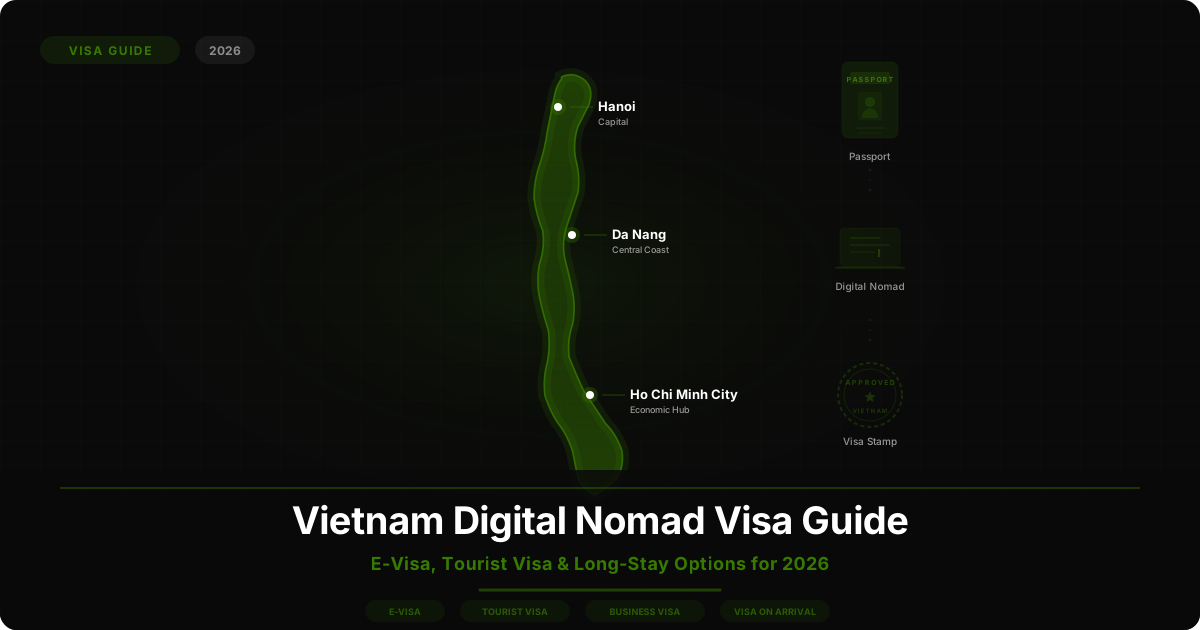
Vietnam does not have a dedicated digital nomad visa, but the 90-day e-visa with multiple entries is the most practical option for most remote workers. It costs $25-50, is available to all nationalities, and can be applied for entirely online. For longer stays, the business visa (up to 1 year) and the new 5-year talent visa offer additional paths. Below is everything I have learned from living and working in Vietnam over the past several years.
If you want the full picture on living, working, and thriving in Vietnam as a remote professional, our Vietnam ebook covers visa strategies, cost-of-living breakdowns, and city-by-city guides in detail.
Quick Overview: Which Visa for Which Situation
Not every visa fits every nomad. Here is a fast decision guide:
- Staying under 90 days, working for foreign clients remotely: E-visa (90-day, multiple-entry).
- Planning to stay 6-12 months with periodic visa runs: E-visa, renewed every 90 days via border crossings.
- Working with or for a Vietnamese company: Business visa with work permit.
- Highly skilled professional with a Vietnamese sponsor: 5-year talent visa.
- High-net-worth investor looking for long-term residency: Golden Visa (proposed, not yet available).
For the majority of digital nomads I have met in Ho Chi Minh City and Da Nang, the e-visa plus occasional visa runs is the standard approach. It is simple, affordable, and well-understood by immigration officers.
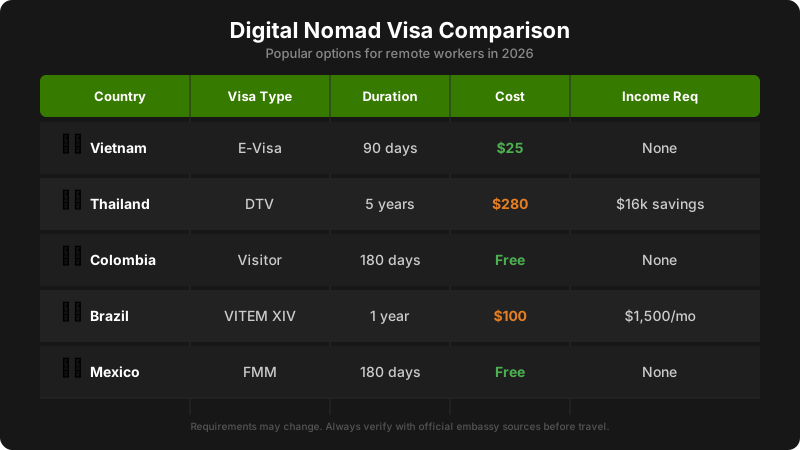
It is worth noting that Vietnam’s lack of a formal nomad visa puts it behind countries like Thailand (DTV: 180 days, extendable), Colombia (2-year nomad visa), and Brazil (1-year nomad visa, $1,500/month income requirement). If legal clarity matters to you, those countries offer a more defined framework. But Vietnam’s low cost and ease of the e-visa process keep it competitive despite the gray area.
E-Visa (90 Days, Multiple Entry)
The e-visa is the backbone of most digital nomad stays in Vietnam. Here is how to get one.
Step-by-Step Application
- Go to the official portal. Visit the Vietnam Immigration Department’s e-visa site at https://evisa.xuatnhapcanh.gov.vn. This is the only official site — avoid third-party lookalikes that charge inflated fees.
- Fill out the application form. You will need your passport details, a passport-style photo (4x6 cm, white background), and your planned entry and exit dates.
- Pay the fee. The standard fee is $25 USD for most nationalities. Some countries pay up to $50. Payment is by credit or debit card.
- Wait for processing. Standard processing takes 3 business days. I have seen approvals come through in as little as 1 day, but do not count on it.
- Download and print your e-visa. You will receive an approval letter via email. Print it — some border officers still want a hard copy, even though digital copies are increasingly accepted at airports.
- Enter Vietnam. Present your printed e-visa and passport at immigration. E-visas are accepted at all international airports, major land borders, and select seaports.
Cost
- Standard fee: $25 USD (single nationality rate)
- Higher-fee nationalities: Up to $50 USD
- Agency markup (if applicable): $15-40 on top of the government fee
Processing Time
- Standard: 3 business days
- Typical range: 1-5 business days
- Rush processing: Not officially available through the government portal. Some agencies claim expedited service.
Extension Options
Extending an e-visa inside Vietnam is possible but inconsistent. Some immigration offices in Ho Chi Minh City and Hanoi will grant a 30-day extension for around $10-50. However, this is not guaranteed. The more reliable option is a visa run (covered below).
Business Visa
If you plan to work with Vietnamese companies, attend business events regularly, or need a visa lasting longer than 90 days without border runs, the business visa is the next step up.
When You Need It
- You are employed by or contracting for a Vietnamese company.
- You need a work permit (required for legal employment in Vietnam).
- You want a visa valid for 3, 6, or 12 months.
- You are setting up a business entity in Vietnam.
How to Get It
- Secure a sponsor. You need an invitation letter from a Vietnamese organization. This can be an employer, a business partner, or a licensed visa agency acting as sponsor.
- Apply at a Vietnamese embassy/consulate or use the visa-on-arrival process with your invitation letter.
- Submit documents: Passport with at least 6 months validity, completed application form, passport photo, invitation/approval letter, and the visa fee.
- Receive your visa. Business visas are stamped into your passport, not issued electronically.
Cost
- Single-entry (1-3 months): $25-50
- Multiple-entry (3 months): $50-70
- Multiple-entry (6-12 months): $70-100
- Invitation letter via agency: $50-150 (varies by agency and visa duration)
Sponsors
If you do not have a Vietnamese business contact, several licensed agencies can provide sponsorship letters. I have used agencies in District 1, Ho Chi Minh City, with good results. Always verify the agency is licensed by checking reviews and asking for their business registration number.
Golden Visa Update
The Vietnam Golden Visa has generated significant discussion among long-term expats and investors, but here is the reality as of March 2026.
What Has Been Proposed
The Golden Visa concept, discussed publicly by Vietnamese government officials since 2023, would offer a 10-year residency visa to qualifying individuals. The proposal targets:
- Foreign investors meeting a minimum capital threshold (rumored at $500,000+ USD)
- Executives of companies with significant operations in Vietnam
- Individuals contributing to priority sectors (technology, education, healthcare)
Current Status
As of March 2026, the Golden Visa has not been formally implemented. There is no application process, no official fee schedule, and no designated government office handling applications. Several rounds of policy discussion have occurred, and draft regulations have circulated, but nothing has been enacted into law.
Who It Would Be For
If and when it launches, the Golden Visa would primarily serve high-net-worth individuals and corporate executives — not the typical digital nomad. The capital requirements alone would put it out of reach for most remote workers. That said, it is worth watching. Vietnam’s government has shown a clear interest in attracting foreign talent and investment, and this visa could eventually become a path for established entrepreneurs.
For official updates, monitor the Vietnam Ministry of Public Security and the Vietnam Immigration Department.
5-Year Talent Visa
The 5-year talent visa is a newer option targeting skilled professionals. It is distinct from the standard business visa and carries a longer validity period.
Eligibility
- Professionals in technology, science, education, healthcare, and other government-designated priority sectors.
- Typically requires a sponsoring Vietnamese organization (university, research institute, tech company, or government body).
- Documented professional qualifications: advanced degrees, published research, or significant industry experience.
- Clean criminal background check from your home country.
Application Process
- Identify a Vietnamese sponsor. Your sponsor submits a request to the relevant ministry or provincial authority.
- Compile documentation. Passport, CV, degree certificates (apostilled or notarized), criminal background check, and a letter from your sponsor explaining the role.
- Sponsor submits the application to the Vietnam Immigration Department on your behalf.
- Approval and visa issuance. If approved, you receive a 5-year visa stamped in your passport. Processing times vary but typically take several weeks to a few months.
Practical Considerations
This visa is not a quick process. It requires genuine institutional backing and documented expertise. I have spoken with professionals in Hanoi who went through the process, and the consensus is that having a well-connected sponsor makes or breaks the application. If you are a freelance remote worker without ties to a Vietnamese organization, this visa is likely not your path.
Visa Runs: How Nomads Extend Their Stays
The visa run is a rite of passage for long-term nomads in Vietnam. Here is how it works.
The Basic Process
- Apply for a new e-visa online before your current visa expires. You can apply for a new e-visa while still in Vietnam.
- Travel to a neighboring country before your current visa’s expiration date.
- Spend at least one night (not strictly required, but some immigration officers look unfavorably on same-day returns).
- Re-enter Vietnam on your fresh e-visa.
Popular Border Run Destinations
Phnom Penh, Cambodia
- Flight from Ho Chi Minh City: ~45 minutes, $50-120 round trip.
- Bus from Ho Chi Minh City: 6-7 hours, $10-20 each way.
- Cambodia e-visa: $36 USD. Visa on arrival also available at airports.
- Good option if you are based in southern Vietnam.
Vientiane, Laos
- Flight from Hanoi: ~1 hour, $60-150 round trip.
- Bus from Hanoi to the border and onward: 10-12 hours total.
- Laos visa on arrival: $30-42 USD depending on nationality.
- Best for those based in northern Vietnam.
Bangkok, Thailand
- Flight from Ho Chi Minh City or Hanoi: 1.5-2 hours, $80-200 round trip.
- Thailand allows visa-free entry for most nationalities (30 days).
- A favorite for nomads who want to combine a visa run with a change of scenery.
Frequency and Limits
There is no hard legal limit on how many times you can enter Vietnam on consecutive e-visas. However, immigration officers have discretion, and frequent same-day border crossings can raise questions. My approach has been to spend at least 2-3 days in the neighboring country, which also keeps things enjoyable rather than stressful.
Pricing Comparison: All Visa Types
| Visa Type | Duration | Cost (USD) | Entry Type | Processing Time | Best For |
|---|---|---|---|---|---|
| E-Visa | 90 days | $25-50 | Multiple entry | 1-5 business days | Most digital nomads |
| Business Visa (single) | 1-3 months | $25-50 + sponsor fee | Single entry | 5-7 business days | Short business trips |
| Business Visa (multi) | 3-12 months | $50-100 + sponsor fee | Multiple entry | 5-10 business days | Long-term workers |
| 5-Year Talent Visa | 5 years | Varies (sponsor-dependent) | Multiple entry | Several weeks to months | Skilled professionals |
| Golden Visa | 10 years (proposed) | TBD (likely $500K+ investment) | TBD | Not yet available | High-net-worth investors |
Common Mistakes to Avoid
After years of navigating Vietnam’s visa system myself and watching other nomads stumble, here are the errors I see most often.
1. Using unofficial e-visa websites. The only official site is evisa.xuatnhapcanh.gov.vn. Dozens of copycat sites charge 3-5 times the real fee for the same service.
2. Letting your visa expire. Overstaying even one day can result in fines of $25 per day, deportation, and entry bans. Set a calendar reminder at least 2 weeks before expiry.
3. Not printing your e-visa. Some land border checkpoints still require a printed copy. Do not rely solely on showing it on your phone.
4. Assuming extensions are automatic. In-country visa extensions are discretionary, not guaranteed. Always have a backup plan (a booked flight or bus to a neighboring country).
5. Ignoring passport validity requirements. Your passport must have at least 6 months of validity remaining at the time of entry. I have seen people turned away at boarding gates for this.
6. Surrendering your passport to unlicensed agencies. Only hand your passport to licensed immigration agencies, and always get a receipt. Scams involving held passports do occur.
7. Working for Vietnamese clients without a work permit. If you are earning income from Vietnamese sources, you technically need a business visa and a work permit. Enforcement is inconsistent, but penalties can be severe.
8. Not having health insurance. Vietnam does not require proof of health insurance for e-visa entry, but that does not mean you should skip it. Hospital bills for anything beyond a basic clinic visit add up fast, and medical evacuation to Bangkok or Singapore is expensive.
💡 Tool tip: SafetyWing offers Nomad Insurance starting at ~$45/month that covers 180+ countries including Vietnam. You can sign up after you have already left home, which makes it ideal for nomads who did not arrange coverage before departure.
What About Working Legally? Tax Implications and Business Registration
This is the section most nomad guides skip, but it matters.
Tax Residency
Vietnam considers you a tax resident if you spend 183 days or more in the country within a calendar year. Tax residents are subject to personal income tax (PIT) on worldwide income, with rates ranging from 5% to 35% depending on income level.
If you stay under 183 days, you are generally taxed only on Vietnam-sourced income (if any). Most digital nomads working exclusively for overseas clients and staying under 183 days do not trigger Vietnamese tax obligations, but this is a gray area that evolves as enforcement tightens.
Business Registration
If you want to operate legally and invoice Vietnamese clients, you need to establish a legal entity. Options include:
- Representative office: Allows market research and liaison activities but not direct revenue generation in Vietnam.
- Limited liability company (LLC): The most common structure for foreign-owned businesses. Requires registered capital (minimums vary by industry) and a local office address.
- Branch office: For companies already established outside Vietnam that want a local presence.
Setting up an LLC as a foreigner typically costs $1,000-3,000 USD in legal and registration fees and takes 4-8 weeks.
Practical Advice
Most digital nomads working for foreign clients do not register a Vietnamese business. The practical reality is that enforcement against remote workers earning foreign income is minimal. However, the legal landscape is shifting. Vietnam is increasingly aware of the digital nomad population and may introduce clearer regulations. Keep records of your income sources and consult a local accountant if you plan to stay long-term.
💡 Tool tip: Vietnam blocks access to some foreign websites and services intermittently. NordVPN lets you access your home banking portals, streaming services, and work tools reliably from anywhere in the country. It also secures your connection on the cafe and coworking Wi-Fi networks you will be using daily.
For more on tax strategies and legal setup, our Vietnam ebook walks through the details with country-specific examples.
Frequently Asked Questions
Does Vietnam have a digital nomad visa? No. As of March 2026, Vietnam does not offer a dedicated digital nomad visa. The most common option for remote workers is the 90-day multiple-entry e-visa, which costs $25-50 and is available to all nationalities.
How long can I stay in Vietnam on an e-visa? The e-visa allows a maximum stay of 90 days per entry. It is multiple-entry, so you can leave and re-enter within its validity period. Extensions are possible through local travel agencies or immigration offices but are not guaranteed.
Can I work remotely on a Vietnam tourist or e-visa? Vietnam’s e-visa does not explicitly authorize employment. Most digital nomads working for foreign clients use it without issues, but it is technically a gray area. If you are working for a Vietnamese company or earning local income, you need a business visa or work permit.
What is the Vietnam Golden Visa? The Golden Visa is a proposed 10-year residency visa for high-net-worth individuals and investors. As of early 2026, it has been discussed by the Vietnamese government but has not been formally implemented. No application process is currently available.
How do visa runs work from Vietnam? A visa run involves leaving Vietnam before your visa expires and re-entering on a new e-visa. Popular destinations include Phnom Penh (Cambodia), Vientiane (Laos), and Bangkok (Thailand). You apply for a fresh e-visa online before your trip, then cross the border and return.
What is the 5-year talent visa for Vietnam? The 5-year talent visa targets skilled professionals in technology, science, education, and other priority sectors. Applicants typically need a sponsoring Vietnamese organization, relevant qualifications, and documented professional experience in their field.
Do I need to pay taxes in Vietnam as a digital nomad? If you stay in Vietnam for 183 days or more within a calendar year, you may be considered a tax resident. Tax residents are subject to Vietnamese personal income tax on worldwide income. Consult a local tax advisor for guidance specific to your situation.
Can I extend my Vietnam e-visa without leaving the country? Extensions are sometimes possible through immigration offices or licensed travel agencies, but they are not guaranteed. The safest approach is to do a visa run to a neighboring country and re-enter on a new e-visa.
How much does a Vietnam business visa cost? A single-entry business visa typically costs $25-50, while a 1-year multiple-entry business visa can cost $50-100 depending on your nationality and whether you use an agency. You also need an invitation letter from a Vietnamese sponsor, which agencies can arrange for an additional $50-150.
Is it safe to use visa agencies in Vietnam? Many reputable agencies operate in Vietnam and handle visa extensions, business visa sponsorship, and invitation letters. Stick to well-reviewed agencies, verify their licensing, and never surrender your original passport without a receipt.
Sources and Official Resources
- Vietnam Immigration Department — E-Visa Portal — Official e-visa application site.
- Vietnam Ministry of Public Security — Government body overseeing immigration policy.
- Vietnam Ministry of Foreign Affairs — Visa Information — Embassy and consulate visa details.
- Cambodia E-Visa — For planning visa runs to Cambodia.
- Thailand Immigration Bureau — Entry requirements for Thailand visa runs.
Keep Reading
- Cost of Living in Vietnam for Digital Nomads: 2026 City-by-City Breakdown — Da Nang, Ho Chi Minh City, Hanoi, and Hoi An budgets at three spending tiers
- Dubai vs Vietnam for Digital Nomads 2026 — Head-to-head comparison on cost, safety, visas, and lifestyle
- Thailand DTV Guide for Remote Workers in 2026 — Planning a visa run to Thailand? Here is everything you need to know about the DTV
Related Reading
- Welcome to the Digital Nomad Guide Series — An overview of what this guide series covers and what is coming next.
- 5 Best Virtual Phone Number Apps for Digital Nomads in 2025 — Stay connected while hopping between countries with a reliable virtual number.
Ready to move to Vietnam? The Digital Nomad Guide: Vietnam covers everything in this guide and more — 200+ pages of visa walkthroughs, cost breakdowns, coworking reviews, and neighbourhood-level city guides. Get the PDF direct (+ exclusive bonuses) for $15, or on Amazon for $9.99.
I am Joe Atlas, and I have been navigating Vietnam’s visa system since my first trip to Saigon in 2019. This guide reflects what I have learned firsthand, cross-checked against official sources. Visa rules change — always verify current requirements on the official e-visa portal before applying.