Where Digital Nomads Are Going After Dubai: 7 Safe Alternatives in 2026
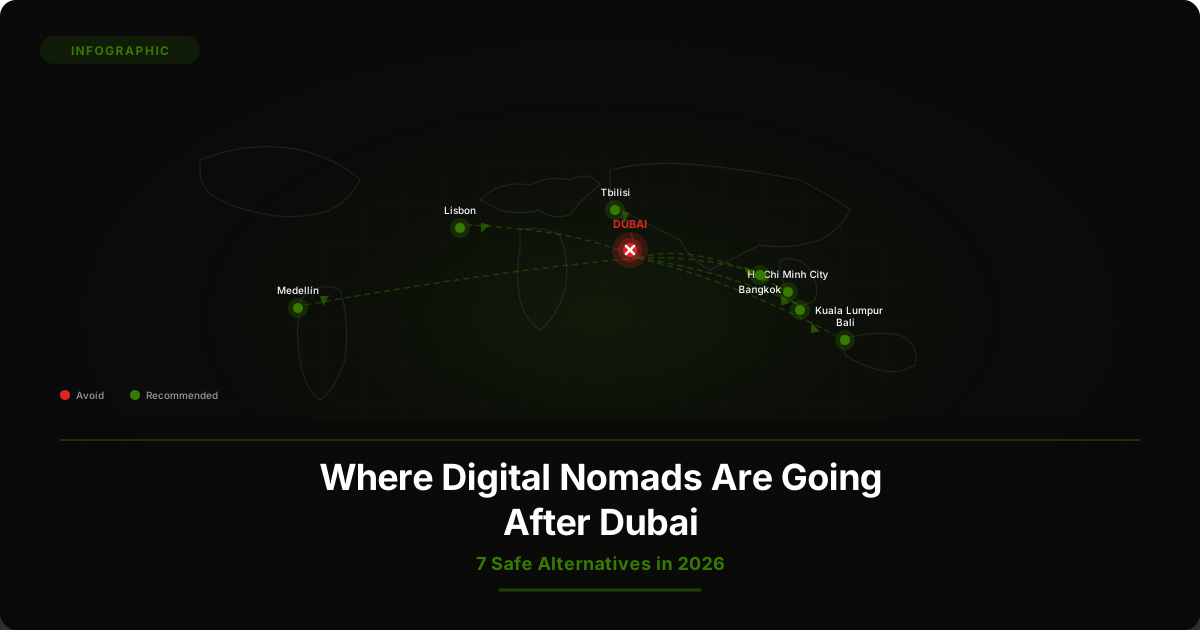
TL;DR: If you are leaving Dubai due to the ongoing Middle East conflict disruptions, your best options in March 2026 are Vietnam (cheapest, best value), Thailand (easiest logistics), and Portugal (closest timezone to Europe and US East Coast). All seven destinations below offer stable internet, functioning visa pathways, and monthly costs well below what you were paying in Dubai. I have lived or worked from each of these places, and this guide reflects that firsthand experience.
The situation in Dubai deteriorated faster than most of us expected. As of early March 2026, the Iran-US/Israel conflict has led to over 23,000 flight cancellations across Gulf carriers, with Emirates operating at roughly 60% capacity. Coworking spaces in Business Bay and JLT are half-empty. The nomad Telegram groups I am in have shifted from “best brunch spots in Dubai Marina” to “who has a spare seat on tomorrow’s flight to Bangkok.”
I left Dubai myself in late February. This is not a theoretical list — these are the places where people I know are actually landing right now, and where I have personally worked. Below, I break down each destination by cost, visa, internet, timezone, and the one thing that makes it stand out.
If you are still sorting out logistics like keeping a working phone number while you relocate, I wrote a guide on the best virtual phone number apps for digital nomads that covers exactly that.
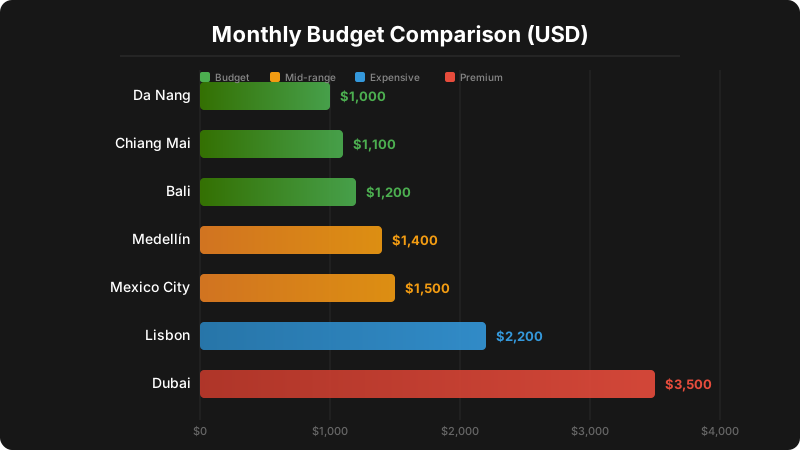
Quick Comparison Table
| Destination | Monthly Cost (USD) | Visa Option | Avg. Internet Speed | Timezone (UTC) | Best For |
|---|---|---|---|---|---|
| Vietnam | $1,000-$1,500 | E-visa (90 days) | 50-80 Mbps | +7 | Best overall value |
| Thailand | $1,200-$1,800 | DTV / Visa-exempt | 50-100 Mbps | +7 | Easiest transition |
| Portugal | $2,000-$3,000 | Digital Nomad Visa | 150-200 Mbps | 0 / +1 | Europe/US timezone overlap |
| Colombia | $1,200-$1,800 | Digital Nomad Visa | 30-80 Mbps | -5 | US timezone alignment |
| Bali, Indonesia | $1,300-$2,000 | B211A (6 months) | 30-60 Mbps | +8 | Community and lifestyle |
| Georgia | $800-$1,400 | Visa-free (1 year) | 40-80 Mbps | +4 | Lowest barrier to entry |
| Malaysia | $1,200-$1,800 | DE Rantau / eVisa | 100-300 Mbps | +8 | Infrastructure and speed |
1. Vietnam — Best Overall Value
Monthly cost: $1,000-$1,500 Visa: E-visa grants 90 days, single or multiple entry. Extensions available in-country. Internet: 50-80 Mbps average in Ho Chi Minh City and Da Nang. Fiber is widespread in urban centers. Timezone: UTC+7 — overlaps with Asian business hours and early-morning Europe calls. Key selling point: Dollar-for-dollar, Vietnam gives you the most comfortable nomad life anywhere on this list.
Vietnam is where I spent the longest stretch of my nomad career, and it is the destination I recommend first to anyone evacuating Dubai on a budget. Ho Chi Minh City has a deep coworking scene — spaces like Dreamplex and CirCO run $80-$120/month for a hot desk with reliable fiber. Da Nang gives you a beach lifestyle with lower rent (a furnished one-bedroom runs $350-$500/month) and a growing community of remote workers.
The food alone justifies the move. You can eat three full meals a day from street vendors and local restaurants for $8-$12. The 90-day e-visa is straightforward to obtain online, and many nomads chain back-to-back visas with a quick trip to Bangkok or Singapore in between.
The biggest adjustment coming from Dubai is the traffic — motorbike culture is intense — and the bureaucracy around banking. But for pure cost-of-living-to-quality-of-life ratio, nothing else comes close.
💡 Tool tip: Moving money out of your UAE bank account? Wise gives you the real exchange rate with ~0.5% fees and lets you hold multiple currencies including AED and VND. It is the simplest way to transfer your savings without losing 2-4% to traditional bank conversion fees.
For a deep dive on Vietnam specifically, check out The Digital Nomad Guide: Vietnam — it covers visas, neighborhoods, coworking spaces, SIM cards, banking workarounds, and month-by-month budgeting in detail.
2. Thailand — Easiest Transition from Dubai
Monthly cost: $1,200-$1,800 Visa: Destination Thailand Visa (DTV) for up to 180 days, or visa-exempt entry for 60 days for most nationalities. Internet: 50-100 Mbps. AIS Fibre and True Online offer reliable home connections. Timezone: UTC+7 — same as Vietnam, good for APAC and partial EU overlap. Key selling point: The most established digital nomad infrastructure in Southeast Asia.
Thailand is where most Dubai evacuees are heading first, and for good reason. Bangkok and Chiang Mai have the most mature nomad ecosystems in the region. Chiang Mai alone has dozens of coworking spaces, and the monthly cost of a comfortable life — including a modern studio, coworking membership, gym, and eating out daily — sits comfortably around $1,500.
The Destination Thailand Visa (DTV) launched in mid-2024 and remains the best long-stay option for remote workers. It grants 180 days with a possible 180-day extension, and the application process is relatively painless compared to older Thai visa categories.
Bangkok is the better pick if you need international-grade hospitals, global food options, and direct flights everywhere. Chiang Mai is where you go when you want a slower pace and a tight-knit nomad community. Either way, the transition from Dubai is smooth — Thailand is well practiced at absorbing waves of location-independent workers.
3. Portugal — Best for US and European Timezone Overlap
Monthly cost: $2,000-$3,000 Visa: Digital Nomad Visa (D8) for non-EU citizens. Requires proof of remote income (minimum ~$3,580/month). Internet: 150-200 Mbps average in Lisbon and Porto. NOS and MEO fiber are excellent. Timezone: UTC+0 (WET) / UTC+1 (WEST in summer) — ideal for EU teams and still overlaps with US East Coast mornings. Key selling point: The only destination on this list that puts you in a European timezone with top-tier internet.
Lisbon has been a nomad magnet for years, and the infrastructure reflects it. Coworking spaces like Second Home and Outsite run $150-$250/month. The D8 digital nomad visa provides a clear legal pathway, and Portugal’s NHR (Non-Habitual Resident) tax regime — while less generous than it was pre-2024 — still offers favorable treatment for foreign-sourced income in many cases.
The downside is cost. Lisbon rents have climbed sharply. A one-bedroom in a central neighborhood now runs $1,200-$1,800/month. Porto and smaller cities like Braga offer better value, with rents 30-40% lower.
If your clients or team are primarily in Europe or the US East Coast, Portugal is the strongest timezone play on this list. You can take a 9am London call and a 2pm New York call on the same day without wrecking your schedule.
4. Colombia — Best for US-Aligned Remote Workers
Monthly cost: $1,200-$1,800 Visa: Digital Nomad Visa (Visa Nomada Digital) valid for up to 2 years. Requires proof of $3,000+/month income. Internet: 30-80 Mbps in Medellin and Bogota. Fiber availability is growing but inconsistent outside city centers. Timezone: UTC-5 — identical to US Eastern Time. Key selling point: Perfect alignment with US business hours at a fraction of US living costs.
Medellin remains the top pick for nomads whose work revolves around US clients and teams. The timezone match is exact — no mental math required. The city’s El Poblado and Laureles neighborhoods are packed with coworking spaces, and a furnished apartment in Laureles runs $500-$800/month.
Colombia’s digital nomad visa, introduced in 2022, is one of the more generous options globally. It allows stays of up to two years and the income threshold of roughly $3,000/month is achievable for most remote professionals. The application can be completed online through the Colombian Ministry of Foreign Affairs.
Internet is the main caveat. While Medellin averages 50-80 Mbps on fiber, connections can be spotty during heavy rain, and backup options (mobile hotspots via Claro or Movistar) are essential. Always test the Wi-Fi before signing a lease.
If Colombia’s cost appeals to you but you want a beach lifestyle, also consider Brazil. The country’s digital nomad visa requires only $1,500/month in income and grants a full year of legal residency. Coastal towns like Praia da Pipa in the northeast offer monthly costs in the $1,100-1,600 range — competitive with Medellin but with a beach-town pace. Pipa Market is a useful resource for understanding property prices and availability in the area before you commit.
5. Bali, Indonesia — Best for Community and Lifestyle
Monthly cost: $1,300-$2,000 Visa: B211A remote worker visa for up to 6 months. Also available: visa-on-arrival (30 days, extendable to 60). Internet: 30-60 Mbps in Canggu and Ubud. Starlink adoption has improved reliability in more remote areas. Timezone: UTC+8 — works for APAC teams and overlaps with late EU afternoon. Key selling point: The most active and social digital nomad community in the world.
Bali barely needs an introduction. Canggu is the epicenter — Dojo Bali and Outpost remain the flagship coworking spaces, and the social scene is unmatched. If you are coming from Dubai and value a strong in-person community of other remote workers, Bali delivers that better than anywhere else.
The B211A visa has become the standard pathway for nomads staying longer than 60 days. It requires a sponsor (easily arranged through visa agents for $200-$300) and grants up to 180 days. Indonesia has been exploring a dedicated digital nomad visa, though as of March 2026 the B211A remains the practical option.
Costs in Canggu have crept up — a villa with a pool that was $600/month in 2022 now runs $900-$1,200. But the overall package of weather, community, wellness infrastructure, and social life keeps people coming back.
6. Georgia — Lowest Barrier to Entry
Monthly cost: $800-$1,400 Visa: Visa-free for citizens of 95+ countries for up to one full year. No application needed. Internet: 40-80 Mbps in Tbilisi. Magti and Silknet offer affordable fiber packages. Timezone: UTC+4 — bridges European and Central Asian business hours. Key selling point: One-year visa-free entry with no paperwork, at the lowest cost on this list.
Georgia is the sleeper pick. Tbilisi offers a genuinely affordable European-adjacent lifestyle — a central one-bedroom apartment runs $400-$600/month, a meal at a local restaurant costs $4-$7, and coworking spaces like Terminal and Impact Hub charge $80-$120/month.
The visa situation is unbeatable. Citizens of the EU, US, Canada, Australia, and dozens of other countries can enter Georgia and stay for up to 365 days with zero paperwork. No visa application, no income proof, no registration. You land and you are legal for a year.
The tradeoffs are limited international flight connections (Istanbul is the main hub) and a smaller nomad community compared to Southeast Asia. But if you want maximum runway on a limited budget while the Middle East situation sorts itself out, Georgia is the most practical choice.
7. Malaysia — Best Infrastructure and Internet
Monthly cost: $1,200-$1,800 Visa: DE Rantau (digital nomad pass) for up to 12 months. Also: eVisa or visa-free entry (90 days for most nationalities). Internet: 100-300 Mbps in Kuala Lumpur and Penang. Unifi and Maxis fiber are widespread and affordable. Timezone: UTC+8 — aligns with Singapore, Hong Kong, and Australian business hours. Key selling point: The fastest and most reliable internet of any budget-friendly destination on this list.
Kuala Lumpur is one of the most underrated nomad cities in the world. The internet is genuinely world-class — 300 Mbps fiber connections are common in condos, and 5G coverage from the major carriers is extensive. If your work involves large file transfers, video production, or anything bandwidth-intensive, KL delivers.
The DE Rantau pass is Malaysia’s answer to the digital nomad visa trend. It grants a 12-month professional visit pass to tech workers and digital professionals, with a relatively straightforward application process through MDEC (Malaysia Digital Economy Corporation).
Penang is the lifestyle alternative — a UNESCO heritage city with incredible food, lower rent ($400-$700/month for a furnished condo), and a laid-back pace. George Town’s coworking scene is smaller but growing.
What to Do Right Now If You Are Leaving Dubai
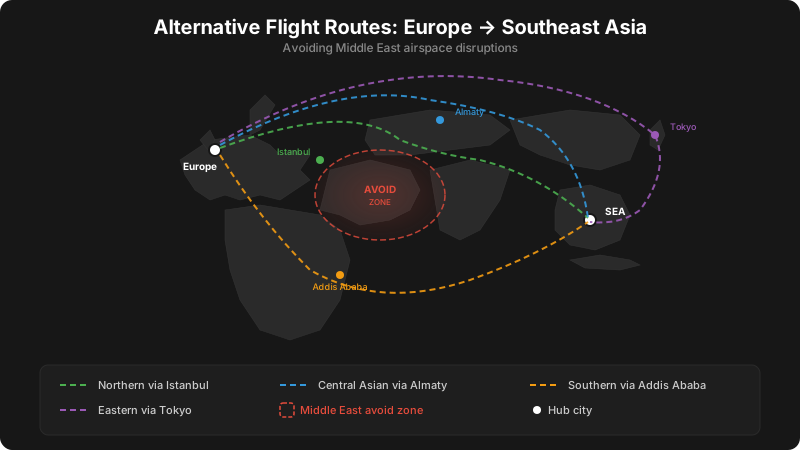
- Book flights through connecting hubs. Direct Gulf routes are unreliable. Route through Istanbul (IST), Mumbai (BOM), or Singapore (SIN) for the most available seats.
- Secure a virtual phone number before you leave, so you do not lose access to UAE-based 2FA and banking. See my guide on virtual phone number apps for digital nomads.
- Document your Dubai lease and contracts. Take screenshots of government travel advisories and GCAA flight restriction notices. These support force majeure claims for early termination.
- Apply for your destination visa now. E-visas for Vietnam and Thailand process in 1-3 business days. Georgia requires no visa at all.
- Set up an eSIM before you fly. Airalo has data eSIMs for 200+ countries with instant activation. Install one for your destination before you board so you have data and maps working the moment you land — no SIM card queue at the airport.
- Get travel insurance that covers trip interruption. SafetyWing and World Nomads both offer policies you can buy after you have already left your home country. SafetyWing’s Nomad Insurance starts at ~$45/month and covers 180+ countries.
If Vietnam is on your shortlist, I genuinely recommend picking up The Digital Nomad Guide: Vietnam before you land. It covers everything from which neighborhoods to target in HCMC and Da Nang, to banking workarounds, SIM card setup, and a realistic month-by-month budget. I wrote it after spending over a year there, and it will save you weeks of figuring things out on your own.
Frequently Asked Questions
Is Dubai safe for digital nomads right now in 2026? As of March 2026, Dubai is experiencing significant disruption due to the Iran-US/Israel conflict in the region. Over 23,000 flights have been cancelled and Emirates is operating at roughly 60% capacity. Many coworking spaces and short-term rentals are seeing mass cancellations. Most travel advisories recommend avoiding non-essential travel to the UAE until the situation stabilizes.
What is the cheapest alternative to Dubai for digital nomads? Vietnam is the most affordable alternative, with a comfortable monthly budget of $1,000 to $1,500 covering rent, food, coworking, and local transport. Ho Chi Minh City and Da Nang offer excellent infrastructure at a fraction of Dubai’s cost. Thailand and Colombia are also strong budget options in the $1,200 to $1,800 range.
Which Dubai alternative has the best internet for remote work? Portugal and Malaysia lead in internet reliability. Lisbon averages 150-200 Mbps on fiber connections, and Kuala Lumpur offers 100-300 Mbps through widespread fiber coverage. Thailand and Vietnam are close behind, with average speeds of 50-100 Mbps in major cities.
Can I get a digital nomad visa in these countries? Portugal, Georgia, and Colombia all offer dedicated digital nomad or remote worker visas. Thailand has its Long-Term Resident visa and Destination Thailand Visa. Indonesia offers the B211A remote worker visa for Bali. Vietnam and Malaysia rely on tourist and e-visa options with periodic border runs or extensions.
Which timezone works best for remote teams in the US and Europe? Colombia (UTC-5) is ideal for US East Coast overlap. Portugal (UTC/UTC+1) is perfect for European teams and still has reasonable overlap with US East Coast mornings. Georgia (UTC+4) bridges European and Asian business hours. Southeast Asian destinations like Vietnam, Thailand, and Malaysia (UTC+7/+8) work best for teams in Asia-Pacific or for asynchronous US work.
How quickly can I relocate from Dubai to one of these alternatives? Most of these destinations offer visa-on-arrival or e-visa processing within 1-3 business days. Georgia allows visa-free entry for most nationalities for up to one year. Thailand and Vietnam e-visas can be approved within 48 hours. The biggest bottleneck is finding available flights out of the Gulf region, so booking through connecting hubs like Istanbul, Mumbai, or Singapore is recommended.
Do I need travel insurance that covers conflict zone evacuation? Standard travel insurance policies typically exclude conflict zones. If you are leaving Dubai due to the current situation, check whether your policy covers trip interruption due to government travel advisories. For your next destination, a policy from SafetyWing or World Nomads that covers emergency evacuation is strongly recommended for any nomad in 2026.
What should I do about my Dubai lease or coworking membership? Most Dubai landlords and coworking operators are offering early termination or freeze options given the circumstances. Document everything in writing, reference government travel advisories in your communications, and check your contract for force majeure clauses. Many nomads have reported successful lease breaks by citing the GCAA flight restrictions.
Disclosure: This article contains affiliate links. If you purchase The Digital Nomad Guide: Vietnam through the Amazon link above, I may earn a small commission at no extra cost to you. All recommendations are based on my personal experience. I only recommend destinations and resources I have used myself.
- Need to keep a working phone number while you relocate? Read my guide on the 5 best virtual phone number apps for digital nomads.
- Planning Vietnam as your next base? Grab The Digital Nomad Guide: Vietnam for the complete playbook on visas, budgeting, coworking, and settling in.
Keep Reading
- How to Fly Europe to Southeast Asia Without Middle East Transit (2026) — Seven alternative routing options with airlines, prices, and journey times
- Vietnam Digital Nomad Visa Guide 2026 — E-visa, business visa, and Golden Visa options for the top-ranked alternative
- Dubai vs Vietnam for Digital Nomads 2026 — A detailed head-to-head comparison if Vietnam is your leading option
- Brazil Digital Nomad Visa Guide for 2026 — Visa pathway, city comparisons, and why Brazil’s coast is attracting post-Dubai nomads